Physical Address
304 North Cardinal St.
Dorchester Center, MA 02124
Physical Address
304 North Cardinal St.
Dorchester Center, MA 02124

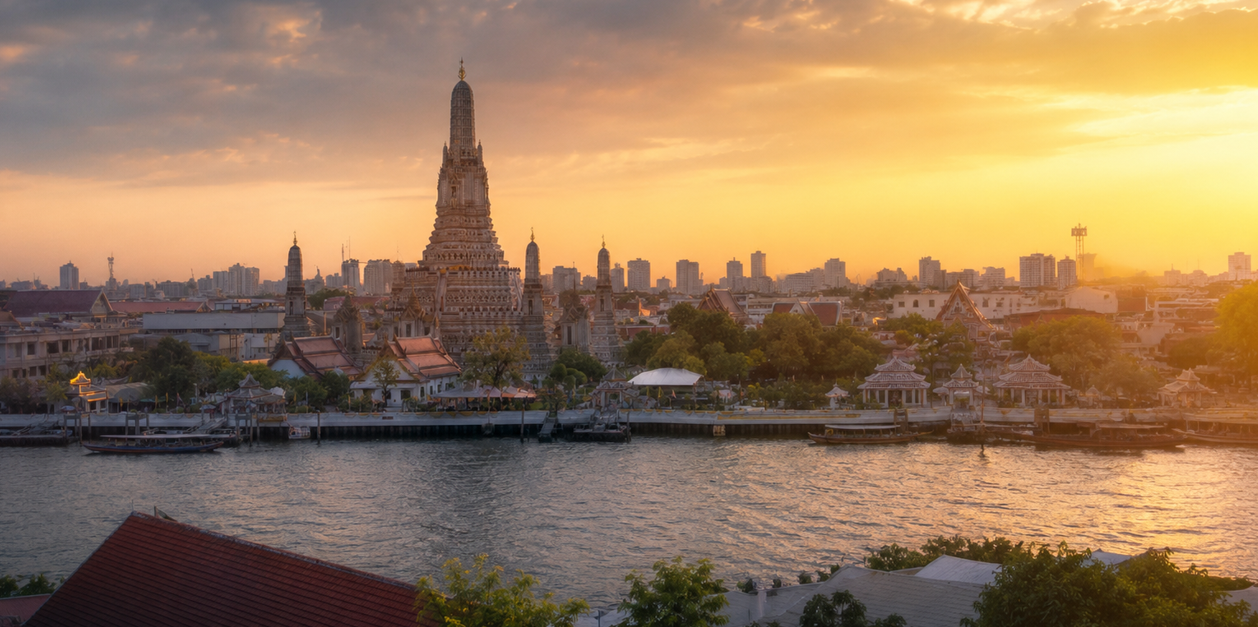
Discover Bangkok temples, culture, and historical places beyond the tourist checklist. Explore Wat Pho, Wat Arun, the Grand Palace, hidden temples, canal life, Thai Buddhist etiquette, local neighborhoods, museums, and the deeper history of old Bangkok.
Bangkok does not reveal itself immediately.
The city arrives in layers. Elevated expressways hang above century-old shophouses. Incense drifts through traffic fumes. Golden temple rooftops appear behind tangled electrical wires and modern malls. Along the Chao Phraya River, monks still move through neighborhoods at dawn collecting alms while ferries carry office workers into the modern financial districts.
For many travelers, Bangkok initially feels chaotic rather than historical. The nightlife, malls, rooftop bars, and street food often dominate first impressions. Yet beneath all of that sits one of Southeast Asia’s richest concentrations of living religious and historical culture.
Bangkok’s temples are not isolated tourist attractions. They are part of the city’s operating system.
They explain why neighborhoods developed where they did. They explain the relationship between the monarchy and religion. They explain why spirit houses stand outside office towers, why families stop to pray before work, why riverside communities still center around temple grounds, and why old Bangkok feels completely different from the glass towers of Sukhumvit.
Most Bangkok temple guides barely scratch the surface. They list the Grand Palace, Wat Pho, and Wat Arun, then move on. What they usually skip is the context, the neighborhoods surrounding these sites, the practical realities of navigating them properly, the hidden temples locals still actively use, and the cultural behavior that actually matters.
This guide is designed differently.
It is for travelers who want to understand Bangkok beyond surface-level sightseeing. It combines history, culture, practical travel advice, hidden places, temple etiquette, transportation tactics, neighborhood exploration, and the deeper historical layers that shaped the Thai capital.
If approached properly, Bangkok’s temples and historical districts become far more than beautiful buildings. They become one of the clearest ways to understand how this city evolved from a riverside trading settlement into one of Asia’s most fascinating urban centers.
Bangkok became the capital of Siam in 1782 when King Rama I established the new Rattanakosin Kingdom after the fall of Ayutthaya and the short Thonburi period under King Taksin.
The location was strategic.
The Chao Phraya River provided trade access, defense, and transportation. Canals were dug to create a protected island-like capital modeled partly after Ayutthaya, the former Siamese capital destroyed by Burmese forces in 1767.
This original historical core is now called Rattanakosin Island.
It remains the ceremonial, spiritual, and historical center of Thailand.
Unlike many historical districts around the world that function mostly as preserved tourist zones, Bangkok’s old city is still deeply active. Temples remain functioning monasteries. Royal ceremonies still occur inside the Grand Palace complex. Local communities still live around these temple districts. Monks still study, pray, and move through daily routines inside spaces visited by millions of travelers.
Understanding this changes how you experience Bangkok.
The temples stop feeling like isolated attractions and begin feeling interconnected.
The river, canals, palace complexes, shrines, and neighborhoods all become part of the same historical story.
Before modern roads, Bangkok functioned almost entirely through waterways.
The Chao Phraya River was the city’s commercial spine. Smaller canals connected neighborhoods, markets, royal compounds, and temples. Trade from China, India, Europe, and across Southeast Asia flowed through these waterways.
Many of Bangkok’s most important temples were deliberately positioned near the river.
This is why approaching old Bangkok by boat feels so natural.
Even today, arriving by Chao Phraya Express Boat gives a far stronger sense of the city’s historical structure than arriving by taxi through heavy traffic.
The river reveals Bangkok properly.
Temple spires rise above the skyline. Ferries cross between old communities. Riverside mosques, churches, shrines, and Buddhist temples appear within short distances of each other.
Bangkok’s multicultural identity becomes immediately visible.
For travelers exploring historical Bangkok seriously, river transport is not just convenient.
It is part of understanding the city.
Rattanakosin Island contains the densest concentration of historical and religious landmarks in Bangkok.
This area includes:
Trying to rush through this area in half a day usually results in exhaustion and shallow sightseeing.
The best approach is slower.
Start early.
Use the river.
Walk between connected areas.
Take breaks during midday heat.
Return in late afternoon when the light softens and temperatures become manageable.
Bangkok’s climate matters more than many travelers expect.
From late morning onward, exposed temple courtyards become intensely hot for much of the year. Heat exhaustion is common among visitors attempting aggressive sightseeing schedules.
The most rewarding experiences in old Bangkok usually happen when travelers stop trying to maximize quantity.
One temple explored slowly often becomes more memorable than five rushed visits.
The Grand Palace is Bangkok’s most famous historical site and the ceremonial heart of the Thai kingdom.
Built in 1782 under King Rama I, the palace complex served as the royal residence for generations and remains deeply important to the monarchy today.
Inside the same compound sits Wat Phra Kaew, the Temple of the Emerald Buddha.
This is Thailand’s most sacred Buddhist temple.
The Emerald Buddha itself is relatively small, carved from green stone often identified as jade or jasper. Despite its size, it carries enormous ceremonial importance.
The king traditionally changes the statue’s seasonal robes three times each year during official ceremonies.
Most visitors arrive unprepared for the scale of the Grand Palace complex.
The site covers a vast area filled with gilded rooftops, murals, throne halls, guardian statues, courtyards, and intricate temple structures.
The architecture reflects centuries of outside influence.
Thai, Chinese, Khmer, and European styles all appear throughout the complex, particularly in later royal buildings constructed during periods of modernization and foreign diplomacy.
One of the most overlooked features is the Ramakien mural gallery surrounding Wat Phra Kaew.
These murals depict the Thai adaptation of the Indian Ramayana epic and stretch across extensive sections of the cloister walls.
Most tour groups rush through quickly.
Travelers who slow down and study the artwork begin noticing incredible details involving mythology, warfare, royal symbolism, and Thai artistic traditions.
The Grand Palace is absolutely worth visiting.
But it rewards patience far more than speed.
A short walk south of the Grand Palace leads to Wat Pho, one of Bangkok’s oldest and most important temples.
Officially known as Wat Phra Chetuphon, the temple complex predates Bangkok’s establishment as the capital.
Today, Wat Pho is famous for its giant Reclining Buddha.
The statue measures 46 meters long and represents the Buddha entering Parinirvana.
Its feet are decorated with mother-of-pearl inlays featuring 108 auspicious symbols connected to Buddhist cosmology.
Yet the Reclining Buddha is only one part of what makes Wat Pho remarkable.
The temple grounds themselves are enormous.
Courtyards contain hundreds of Buddha images, royal chedis, Chinese guardian sculptures, prayer halls, gardens, and shaded walkways.
Compared to the Grand Palace, Wat Pho usually feels calmer and more spacious.
The temple is also historically important as the center of traditional Thai medicine and massage.
Stone inscriptions around the grounds helped preserve ancient medical knowledge and massage techniques.
Today, the Wat Pho Thai Traditional Medical and Massage School remains one of the country’s most respected institutions for Thai massage training.
Receiving a massage here is not simply a tourist activity.
It connects directly to one of Thailand’s most important traditional wellness practices.
Many travelers spend less than thirty minutes at Wat Pho.
That is a mistake.
The quieter corners of the complex often become the most memorable.
Monks crossing courtyards.
Temple bells ringing softly.
Incense drifting through shaded prayer halls.
The sound of chanting in the distance.
Wat Pho feels less performative than the Grand Palace.
It feels lived in.
That atmosphere matters.
Across the river from Wat Pho stands Wat Arun, one of Bangkok’s most visually distinctive temples.
Its central Khmer-style prang rises dramatically above the Chao Phraya River and remains one of the city’s defining landmarks.
The temple dates back to the Ayutthaya period but gained greater significance during the early Bangkok era.
Before the Emerald Buddha moved permanently to Wat Phra Kaew, it was temporarily housed here.
Wat Arun’s exterior is covered in porcelain fragments and decorative ceramics, much of it historically sourced from Chinese trading ships.
Up close, the level of detail is extraordinary.
Floral patterns, mythological figures, and mosaics cover nearly every surface.
From a distance, particularly during sunrise or sunset, the structure seems to glow against the river.
The climb up the central prang is steep but worthwhile.
The upper terraces provide excellent views across the Chao Phraya River toward Rattanakosin.
Wat Arun changes dramatically depending on time of day.
Early morning offers softer light and fewer visitors.
Late afternoon creates stronger golden reflections.
Nighttime views from across the river are equally impressive when the temple becomes illuminated.
Crossing the river itself is part of the experience.
The short ferry ride from Tha Tien Pier costs very little and provides one of the best perspectives of old Bangkok.
Most travelers spend nearly all their time on the eastern side of the river.
That means many completely miss Thonburi.
This older riverside area preserves some of the strongest traces of pre-modern Bangkok.
Wooden houses stand beside canals.
Small community temples appear between residential neighborhoods.
Longtail boats still move through waterways lined with banana trees and stilt structures.
The pace feels noticeably slower.
Exploring Thonburi helps explain why Bangkok was once called the Venice of the East.
The canal system was not decorative.
It was essential infrastructure.
Entire communities depended on water transport for daily life.
Even today, canal exploration remains one of the most historically immersive experiences available in Bangkok.
A good longtail boat ride through Thonburi reveals:
Many tours also stop at Wat Paknam Bhasicharoen.
Wat Paknam has become increasingly well known in recent years because of its enormous seated Buddha statue completed in the early 2020s.
The statue rises above the surrounding district and is now one of Bangkok’s largest Buddha images.
Yet the temple itself has much deeper historical importance.
Wat Paknam is a major center for a meditation tradition developed by the monk Luang Pu Sodh in the twentieth century.
The temple grounds feel far less commercial than Bangkok’s central tourist temples.
Visitors often encounter local worshippers rather than organized tour groups.
Inside the modern stupa, upper levels contain striking cosmological artwork, vivid emerald-colored interiors, and meditation spaces unlike anything found in Bangkok’s older temple compounds.
The contrast between ancient Buddhist traditions and newer monumental architecture makes Wat Paknam especially interesting.
Reaching the temple requires more effort than visiting central Bangkok landmarks.
That extra effort is part of why the atmosphere remains calmer.
Wat Saket sits slightly east of Bangkok’s main riverside temple zone.
Its most famous feature is the Golden Mount, an artificial hill crowned by a golden chedi containing Buddhist relics.
The climb upward passes through shaded pathways lined with bells, trees, and prayer areas.
Compared to Bangkok’s busiest temple compounds, the atmosphere here is quieter and more reflective.
The summit provides one of the best panoramic views over old Bangkok.
Temple rooftops, canals, older neighborhoods, and distant modern skyscrapers become visible together.
That contrast captures Bangkok perfectly.
The Golden Mount is particularly rewarding during:
Unlike some heavily crowded landmarks, Wat Saket still feels approachable and relaxed much of the time.
Wat Suthat is one of Bangkok’s most underrated major temples.
Located near the Giant Swing in the old city, the temple contains some of Thailand’s finest mural work and religious architecture.
The main prayer hall is enormous.
Inside sits the bronze Buddha image Phra Sri Sakyamuni, originally cast during the Sukhothai period.
The surrounding murals are extremely detailed and reward slow observation.
Outside the temple stands the Giant Swing, a towering red structure once used during Brahmin ceremonies connected to royal traditions.
This area reveals an important reality about Thai culture.
Bangkok’s religious identity has never been purely Buddhist.
Brahmanical traditions, Chinese spiritual practices, animist beliefs, and Theravada Buddhism all overlap throughout the city.
Understanding that mixture helps travelers better understand Bangkok itself.
Near Wat Suthat stands one of Bangkok’s most unusual religious structures.
Loha Prasat, often called the Metal Castle, rises through multiple levels topped by dozens of metal spires.
Built during the reign of King Rama III, the structure was inspired by ancient Buddhist architectural forms from India and Sri Lanka.
The interior contains meditation halls, staircases, terraces, and quiet upper walkways with views across old Bangkok.
Unlike the Grand Palace or Wat Pho, Loha Prasat often remains surprisingly uncrowded.
Its atmosphere feels contemplative.
Travelers interested in architecture and quieter temple experiences frequently find it one of Bangkok’s most rewarding hidden historical places.
Bangkok’s identity was shaped heavily by Chinese migration and trade.
One of the best places to experience this heritage is Talat Noi.
Located near the river south of Chinatown, Talat Noi is one of Bangkok’s oldest surviving neighborhoods.
The area contains:
Unlike highly commercial tourist districts, Talat Noi still feels residential.
People live and work here.
Metalworking shops operate beside coffee shops.
Shrines sit between aging apartment blocks.
Old Chinese architecture mixes with modern Bangkok life.
Walking slowly through Talat Noi often becomes one of the most memorable experiences in the city.
One notable site here is So Heng Tai Mansion, a preserved Hokkien-style courtyard house dating back to the nineteenth century.
The mansion reflects the wealth and influence of Chinese merchant families who helped shape Bangkok’s commercial history.
Talat Noi also contains several Chinese shrines filled with incense smoke, red lanterns, offerings, and local worshippers.
These spaces feel deeply atmospheric because they remain active parts of community life.
Temples become far more meaningful when travelers understand the broader historical context around them.
Two museums in old Bangkok help enormously.
Museum Siam presents Thai identity, history, and culture through modern interactive exhibits.
The museum explores:
It is accessible, well-designed, and especially useful for first-time visitors trying to understand Thailand beyond stereotypes.
The Bangkok National Museum is one of Southeast Asia’s largest museums.
Its collections include:
The museum helps connect Bangkok’s temples to broader Thai history stretching back centuries before the current capital existed.
Travelers interested in history should not skip it.
Bangkok’s temples cannot be separated from everyday Thai life.
Buddhism influences routines, social behavior, festivals, family traditions, and public spaces throughout the city.
One of the clearest examples is morning alms giving.
At dawn, monks walk through neighborhoods collecting food offerings from local residents.
This is not a performance.
It is part of a long-standing religious exchange involving merit, generosity, and community support.
Travelers observing this should remain quiet and respectful.
Photography should never feel intrusive.
Women should not physically touch monks.
Inside temples, respectful behavior matters greatly.
Thai people are generally welcoming toward respectful visitors.
Most problems occur when travelers treat temples like entertainment venues rather than sacred spaces.
Outside office towers, restaurants, homes, hotels, and shopping centers across Bangkok, small shrines called spirit houses appear constantly.
These structures reflect older animist traditions that continue alongside Buddhism.
Offerings of flowers, incense, drinks, and food are placed there daily.
The spiritual landscape of Bangkok is layered.
Buddhism exists alongside Chinese folk religion, Brahmanical rituals, and animist practices.
This blending creates much of Bangkok’s distinctive atmosphere.
Travelers who notice these details begin understanding the city differently.
Temple dress codes in Bangkok are real.
At major sites like the Grand Palace, enforcement is strict.
The easiest strategy is simple:
Dress appropriately from the start.
For both men and women:
Linen and cotton work well in Bangkok’s climate.
Comfortable shoes are important because walking distances can become significant.
Many temples require shoe removal before entering interior spaces, so easily removable footwear is useful.
Bangkok rewards slow exploration.
Some of the city’s best moments happen between major landmarks rather than inside them.
The lanes around Phra Nakhon contain:
Walking between temple districts reveals the texture of the city.
The transition from crowded roads into quiet temple courtyards is part of what makes Bangkok memorable.
Travelers who constantly move by taxi often miss this completely.
Timing changes everything in Bangkok.
The difference between visiting a temple at 8 AM versus 1 PM is enormous.
Early mornings provide:
Midday brings:
Late afternoons often become excellent again, particularly for riverside temples.
Trying to fight Bangkok’s climate rarely works.
Working with it improves the entire experience.
The river boat system is one of the most efficient ways to move between historical areas.
It avoids road congestion and connects directly to many major landmarks.
Short ferries linking Wat Pho and Wat Arun are inexpensive and useful.
The MRT Blue Line now reaches several old city areas, making historical Bangkok more accessible than before.
Tuk-tuks can be enjoyable for short rides but are commonly connected to commission-based shopping detours near tourist areas.
If using one:
Walking remains the best way to explore the old city itself.
But Bangkok heat makes hydration essential.
Bangkok is generally manageable for travelers, but common scams still exist around major attractions.
The most famous involves strangers claiming a temple is closed for a holiday or ceremony.
Usually, they then redirect travelers toward gem stores or tailor shops.
Simple rule:
Always verify yourself.
Do not rely on random strangers outside attractions.
Another common issue involves tuk-tuk commission routes.
Drivers may offer unusually cheap rides while planning stops at businesses paying referral commissions.
Being calm, informed, and politely firm solves most situations.
Many cities preserve history behind museum barriers.
Bangkok often keeps history functioning directly inside daily life.
Children play football beside temples.
Monks use smartphones.
River ferries pass centuries-old shrines.
Office workers stop at spirit houses before entering skyscrapers.
Families gather at temples during festivals.
Food vendors operate beside historical walls.
The city’s past never fully separated from its present.
That continuity gives Bangkok much of its character.
This pacing allows travelers to experience Bangkok with far less stress and far more depth.
Early morning is best for cooler weather, softer light, and fewer crowds.
Three to four days allows a balanced pace including temples, museums, neighborhoods, and canal exploration.
Clothing covering shoulders and knees is expected. Lightweight breathable fabrics work best.
Yes. It is one of Bangkok’s most visually distinctive temples and offers excellent river views.
Yes, especially for travelers interested in Bangkok’s older communities and historical waterways.
Wat Saket, Loha Prasat, Wat Suthat, Wat Ratchabophit, and Wat Paknam are excellent options.
Usually yes in many areas, but some sacred halls restrict photography. Always observe posted rules.
Also Read: Bangkok Historic Sites and Temples of Bangkok for more information.
Bangkok’s temples are not simply tourist attractions.
They are the framework around which much of the city historically developed.
The river routes, old neighborhoods, shrines, palace grounds, canal systems, Chinese communities, royal traditions, and Buddhist practices all connect.
Travelers who approach Bangkok slowly begin noticing this interconnectedness everywhere.
The city starts making sense.
The smell of incense outside office towers.
The monks moving quietly through markets.
The river ferries crossing beneath illuminated temples.
The spirit houses standing below skyscrapers.
The old women praying beside teenagers scrolling phones.
Bangkok’s historical and spiritual identity never disappeared.
It simply evolved alongside modern urban life.
That coexistence is what makes the city so compelling.
The travelers who leave Bangkok with the strongest memories are usually not the ones who saw the most places.
They are the ones who slowed down enough to understand what they were actually seeing.
And Bangkok rewards that kind of attention more than almost any city in Asia.
Prices, transport routes, opening hours, and entry fees may change over time. Always verify current information before travel.