Physical Address
304 North Cardinal St.
Dorchester Center, MA 02124
Physical Address
304 North Cardinal St.
Dorchester Center, MA 02124

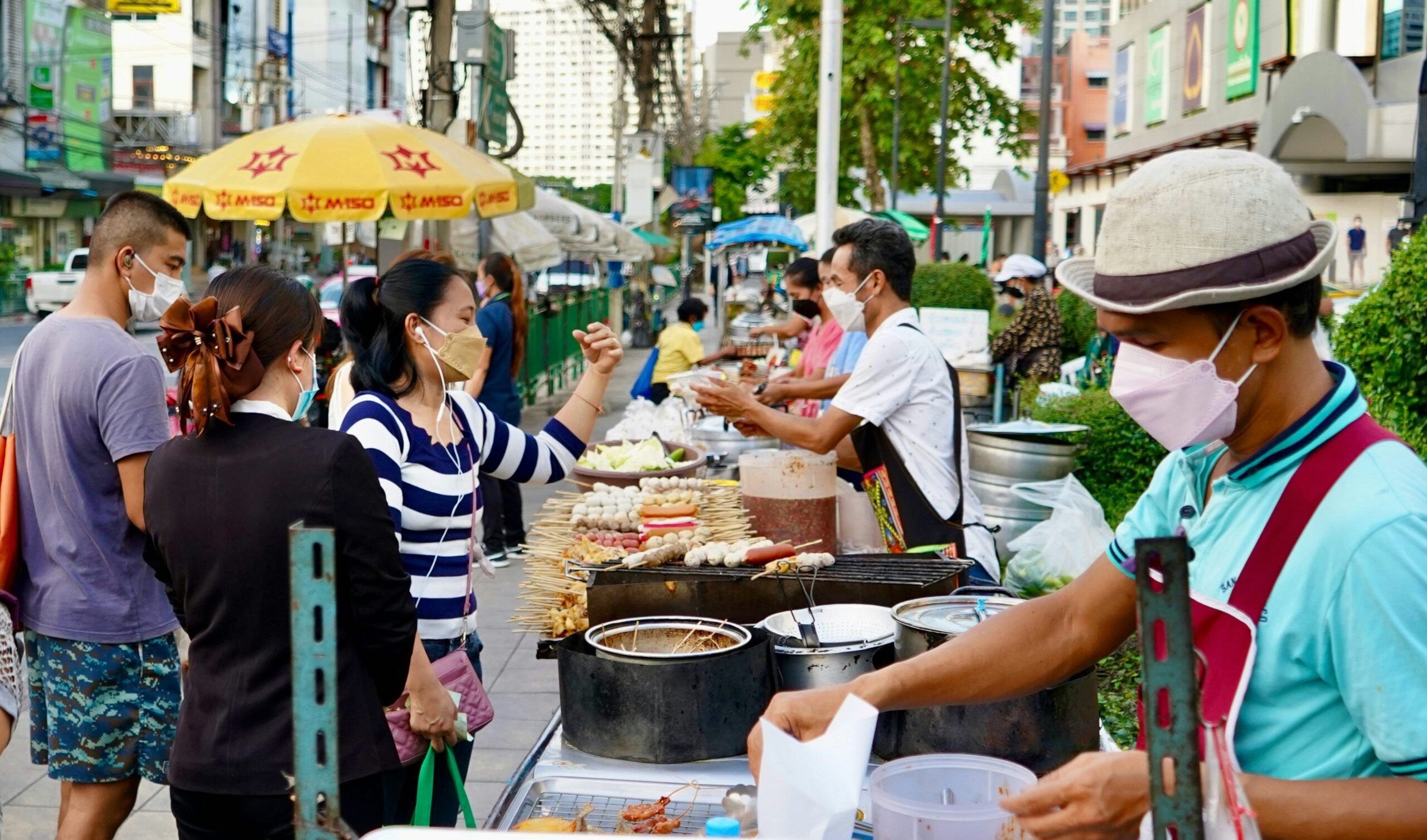
The most complete Bangkok street food guide for 2026. Covers Michelin-recognized stalls, Yaowarat Chinatown, Victory Monument, halal options, hygiene realities, ordering tactics, late-night eats, and neighborhood-by-neighborhood strategy. Bangkok's street food scene is one of the most layered, demanding, and rewarding food cultures on the planet. This tactical guide covers every neighborhood, every key dish, every timing strategy, and every mistake worth avoiding, written for travelers who take food seriously.
Bangkok does not ease people in gently. The city arrives all at once. Heat pushing up from the pavement. Grilled pork smoke trapped under tangled electrical wires. Motorbikes squeezing through impossible gaps. Garlic hitting hot oil somewhere nearby before sunrise. Fish sauce in the humidity. Diesel in the traffic.
And underneath all of that noise is one of the most layered food cultures on earth.
Bangkok street food is not a novelty. It is not an attraction created for tourism. It is infrastructure. Office workers eat on the pavement before work. Students stand beside noodle carts after midnight. Taxi drivers know which stalls stay open until 3am. Entire neighborhoods still revolve around morning porridge vendors and evening grills.
This is not a guide to rooftop restaurants or polished tasting menus. It is a tactical breakdown of how Bangkok actually eats. Which neighborhoods matter. Which dishes belong to which parts of the city. When vendors open. When they sell out. What tourists usually misunderstand. What is genuinely worth waiting for. What is famous because of social media and what is famous because generations of locals still queue there voluntarily.
Bangkok’s street food culture rewards patience and curiosity far more than aggressive checklist tourism. The best meals often happen at places with no branding, no social media strategy, and no English menu.
There is a reason Bangkok repeatedly appears in serious global food conversations. The street food scene here has depth. Technical depth. Historical depth. Regional depth. The Michelin Guide Thailand now recognizes numerous street vendors and shophouse operations because the cooking quality is impossible to ignore.
What matters most is understanding how the city functions.
Bangkok eats according to time.
Breakfast culture is different from dinner culture. Chinatown becomes a different universe after dark. Certain noodle stalls operate only four hours a day. Some vendors are finished by noon. Others only appear after 10pm.
Neighborhoods matter too.
Yaowarat specializes in Thai-Chinese cooking. Victory Monument leans toward aggressive noodle culture and working-class staples. Banthat Thong serves students and younger locals. Sukhumvit has pockets of excellent street food hidden inside one of the city’s most international corridors.
Learning Bangkok street food means learning how to read those layers.
Bangkok does not have one unified street food identity. Several food traditions overlap simultaneously across the city.
There is Thai-Chinese cooking in Yaowarat and Song Wat.
There is central Thai food that dominates many classic dishes tourists recognize first.
There is Isan food from northeastern Thailand, usually louder, smokier, more fermented, and often significantly spicier.
There is Thai-Muslim food concentrated around certain communities and mosques.
There is also the newer café-food hall ecosystem spreading through areas like Ari and Thonglor, though that exists in a different category from Bangkok’s older street food culture.
Each neighborhood reveals different priorities.
A Chinatown roast duck vendor operates differently from a boat noodle stall near Victory Monument. A morning jok vendor serves a completely different crowd than a late-night grilled seafood stall on Yaowarat Road.
Bangkok’s street food culture is also intensely time-sensitive.
Breakfast runs early. Serious breakfast vendors begin around 5:30am or 6am. Lunch crowds peak fast around office districts. Night markets gradually wake up after sunset. Chinatown reaches maximum intensity between roughly 8pm and 11pm.
Another important shift in recent years is the rise of GrabFood and LINE MAN.
Delivery apps permanently changed the ecosystem.
Popular stalls now manage both physical queues and app orders simultaneously. Some vendors reduced seating entirely because delivery demand became more profitable. Others expanded. The result is that certain famous stalls become crowded earlier than they once did.
For travelers, timing matters more now.
Showing up thirty minutes late at a well-known stall can mean doubling the wait.
Most tourists miss Bangkok breakfast culture completely.
Late mornings and slow hotel breakfasts make people overlook one of the city’s best eating periods.
From around 6am until 10am, Bangkok’s food scene feels calmer, more local, and significantly less performative than the evening food circuits tourists usually focus on.
One of the defining breakfast dishes is jok.
Jok is Thai rice porridge. Thick, heavily seasoned, comforting, peppery, and usually topped with minced pork, pork meatballs, ginger, spring onion, and a soft egg cracked directly into the hot bowl.
Jok Prince in Bang Rak remains one of the best-known versions in the city and has earned Michelin Bib Gourmand recognition multiple times. The smoky undertone in the porridge comes from lightly charred rice during cooking, something many cheaper versions lack.
Good jok feels substantial without becoming heavy.
Another breakfast staple is khao tom, a lighter rice soup served in clear broth. It is simpler than jok and often eaten by older locals or people wanting something easier in Bangkok’s heat.
Pa tong go, Thai-style Chinese fried dough sticks, are another important part of the breakfast ecosystem. These are usually eaten with soy milk or strong Thai coffee. Ong Kee in Chinatown remains one of the most respected names for pa tong go.
Freshly made versions should still hold air inside the dough. Bad ones collapse into oily bread almost immediately.
Khao man gai deserves special attention.
Bangkok’s version of Hainanese chicken rice is one of the city’s most important comfort foods. Poached chicken over fragrant rice cooked in chicken fat and broth, served with fermented soybean sauce, ginger, chili, and cucumber.
The Pratunam area has several famous stalls competing for dominance. During morning hours, office workers queue rapidly, eat quickly, and leave.
This is functional food in the best sense.
Thai iced tea and oliang coffee are not secondary details either. Bangkok drink culture is deeply tied to street eating. Vendors often become known for their balance of sweetness, tea strength, and ice ratio.
Some regulars walk past multiple stalls specifically to buy from one trusted drink vendor.
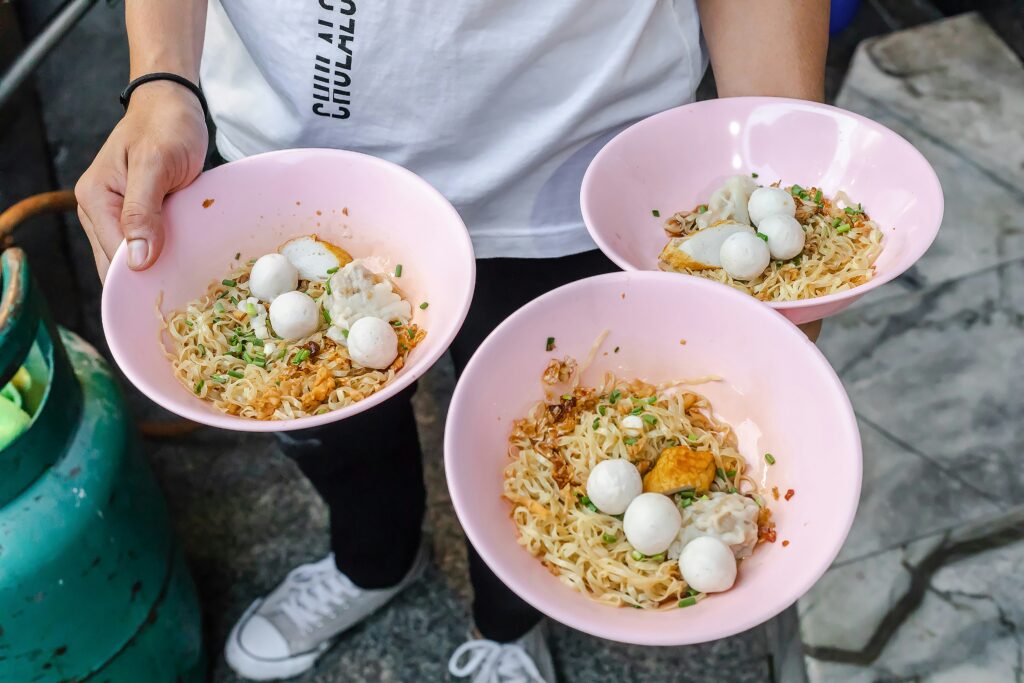
Yaowarat is the gravitational center of Bangkok street food.
Not because every stall there is automatically better than the rest of the city.
Because nowhere else compresses so much food energy into such a concentrated area.
As evening approaches, Yaowarat transforms.
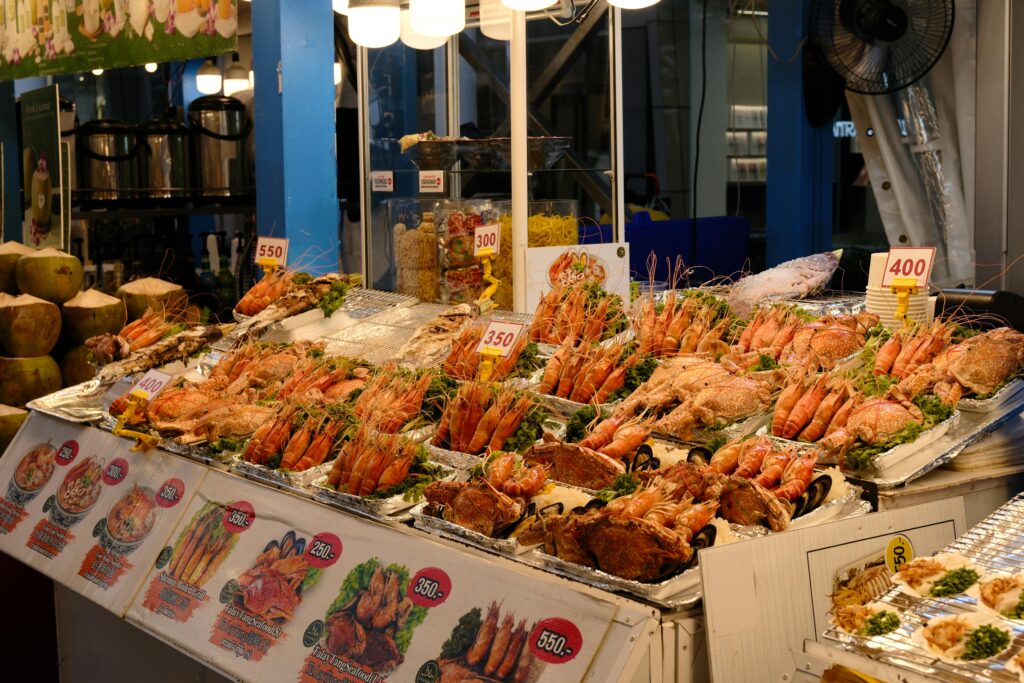
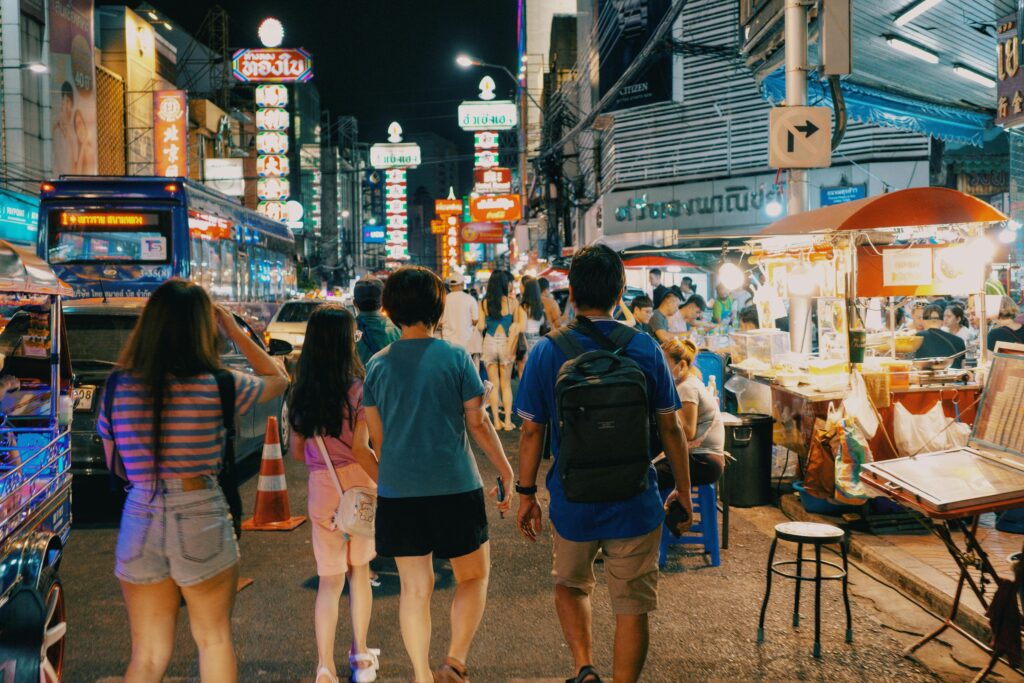
Metal shutters open. Plastic tables appear on pavements. Seafood tanks begin bubbling outside restaurants. Smoke from charcoal grills hangs low over the street. Delivery riders weave through crowds carrying insulated bags larger than their torsos.
The road itself becomes part obstacle course, part open-air dining room.
Bangkok Chinatown was shaped heavily by Teochew Chinese migration, and the food still reflects that influence. Roast meats, noodle soups, seafood, herbal desserts, and pepper-heavy broths dominate the district.
Roast duck is foundational here.
The best versions have lacquered skin with actual crispness underneath the glaze. The meat stays moist. Rice absorbs duck fat and soy sauce. A small bowl of clear broth almost always arrives alongside.
Some vendors have been operating for generations.
The difference between average roast duck and excellent roast duck in Yaowarat is enormous.
Nai Ek Roll Noodles remains one of Chinatown’s most recognizable stalls. The guay jub broth is intensely peppery and loaded with rolled rice noodles, crispy pork belly, and organ meats.
This is not timid food.
The broth should almost sting slightly.
Lim Lao Ngow serves some of Bangkok’s best fishball noodle soup. Handmade fish balls with springy texture, light broth, egg noodles, and classic Thai condiment sets at the table.
Simple dishes matter deeply in Bangkok because the margin for error is small.
A noodle soup with only a few components exposes bad technique immediately.
River prawns are another Chinatown obsession.
Large grilled prawns with bright orange roe inside the head are displayed dramatically outside seafood stalls, but the better places are not simply relying on visuals.
Properly grilled river prawns retain softness in the center while developing slight char on the shell.
The seafood sauce matters too.
Sharp lime, garlic, chili, fish sauce.
Aggressive enough to cut through the richness.
Song Wat Road, slightly away from the main Yaowarat artery, has become increasingly important for food-focused travelers looking beyond the most photographed areas.
Urai Braised Goose earned Michelin Bib Gourmand recognition and remains heavily local in character. The braised goose has deep spice penetration without becoming overly sweet.
The crowd there skews older and almost entirely Thai-Chinese.
Timing is critical in Yaowarat.
Coming too early creates a strangely flat experience because much of the atmosphere builds gradually after sunset. Arriving around 7pm to 8pm usually works best.
The best strategy is not sitting immediately at the first famous stall.
Walk first.
Observe.
Watch which vendors attract repeat local customers.
See where smoke gathers.
See which stalls constantly replenish ingredients.
Then eat in stages.
For transportation logistics and navigating Bangkok’s neighborhoods efficiently, RoamRiot’s Bangkok district breakdown remains useful for understanding how Chinatown connects to the MRT and river system.
The stretch between Chinatown and Bangkok’s Old Town contains some of the city’s most historically important food culture.
This area feels older.
Denser.
More rooted in long-running family businesses rather than trend cycles.
Raan Jay Fai became globally famous after receiving a Michelin star, but long before international media attention, locals already knew the cooking quality there was exceptional.
Jay Fai herself cooks every dish over charcoal while wearing ski goggles to protect against smoke and oil.
The crab omelette became iconic because of the sheer amount of crab folded inside and because the exterior achieves an unusual balance between crispness and softness.
The price is high by Bangkok street food standards.
But this is ingredient-heavy cooking done manually at extreme heat for hours.
Reservations became almost mandatory after Michelin recognition.
Pad kee mao and tom yum seafood there remain excellent too, though the crab omelette dominates public attention.
A short distance away sits Pad Thai Thip Samai.
Touristy now, yes.
Still technically impressive.
The noodles are cooked individually rather than in giant batches, preserving texture and wok aroma. The tamarind balance stays controlled rather than overly sweet.
Good pad Thai should taste layered.
Sweetness, acidity, fish sauce salinity, dried shrimp depth, slight smokiness from the wok.
Not just sugar.
On Lok Yun offers a completely different Bangkok food experience.
Operating since the 1930s, it serves old-school Thai-Chinese breakfast items in a setting that still feels suspended in another era.
Soft-boiled eggs. Kaya toast. Coffee. Condensed milk.
Fans spinning slowly overhead.
Older regulars reading newspapers.
The place matters because it preserves a social atmosphere increasingly disappearing from Bangkok.
Banthat Thong Road near Chulalongkorn University has become one of the city’s strongest food streets for younger Bangkok locals.
The area changes personality throughout the day.
Student lunches. Afternoon snack crowds. Evening dessert runs.
There is less tourist branding here compared to Yaowarat.
More repetition.
Locals returning to specific stalls repeatedly.
Prices remain relatively reasonable too.
Made-to-order fried rice stalls, noodle vendors, Thai desserts, grilled meats, milk toast cafés, and late-night snack shops all coexist within walking distance.
The atmosphere feels energetic without becoming chaotic.
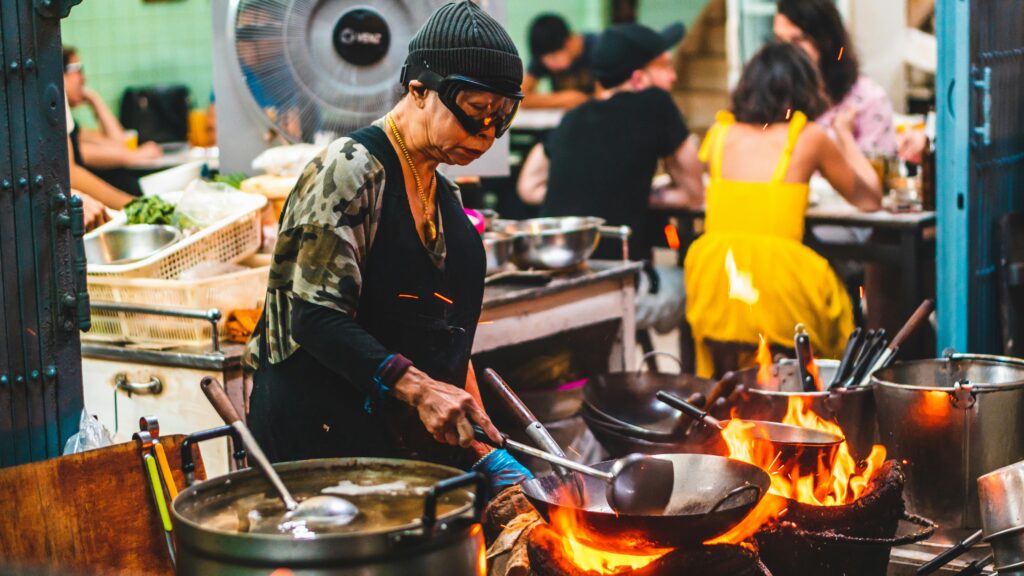
Most travelers treat Victory Monument as a transit point.
That is a mistake.
The food scene around Victory Monument is one of the strongest examples of everyday Bangkok eating culture.
Office workers. Students. Bus passengers. Minivan drivers.
This area feeds people constantly.
Boat noodles dominate the conversation here.
Dark broth enriched with pork or beef blood, noodles, morning glory, pork belly, fried garlic, herbs.
Historically these noodles were sold from boats in tiny bowls, encouraging customers to stack multiple portions.
Some Victory Monument shops still preserve that tradition.
The broth should be rich and concentrated rather than watery.
Sai krok Isan, fermented northeastern Thai sausage, appears on grills throughout the area.
The flavor is slightly sour from fermentation, balanced with pork fat richness.
Served with raw chili, cabbage, peanuts, and ginger.
Perfect drinking food.
Perfect late afternoon food.
The Victory Monument area is also excellent for inexpensive Thai-Muslim dishes like khao mok gai.
Thai biryani differs noticeably from South Asian biryani.
The spice profile is softer. The rice is lighter. The accompanying sauce is often sweet and herbal.
Prices around Victory Monument remain lower than major tourist districts.
That alone makes the area worth understanding.
Sukhumvit is often misunderstood.
Many visitors assume the area is mostly malls, nightlife, and international restaurants.
In reality, the long Sukhumvit corridor contains numerous pockets of serious local food culture, particularly once moving farther away from Nana and Asok.
Soi 38 used to dominate conversations about Sukhumvit street food.
Redevelopment changed much of it.
Some vendors survived, but the atmosphere is no longer what longtime Bangkok residents remember.
Travelers arriving expecting old Bangkok food chaos often leave disappointed.
The stronger strategy now is exploring local-heavy areas like On Nut.
On Nut Market and surrounding streets contain excellent low-cost daily food culture.
Rice-and-curry stalls. Fish cakes. Stir-fries. Grilled meats. Khanom jeen noodle dishes.
This is neighborhood food rather than performance food.
Khlong Toey Market is another essential stop for anyone wanting to understand Bangkok beyond polished travel content.
This is not a sanitized attraction.
It is one of Bangkok’s largest wet markets and supplies ingredients to restaurants, vendors, and households across the city.
Visiting around sunrise reveals seafood deliveries, meat breakdown stations, herb vendors, and produce piled floor to ceiling.
The smell is intense.
Fish.
Ice.
Blood.
Fresh basil.
Durian.
Cooking begins long before tourists wake up.
Khlong Toey makes that reality impossible to ignore.
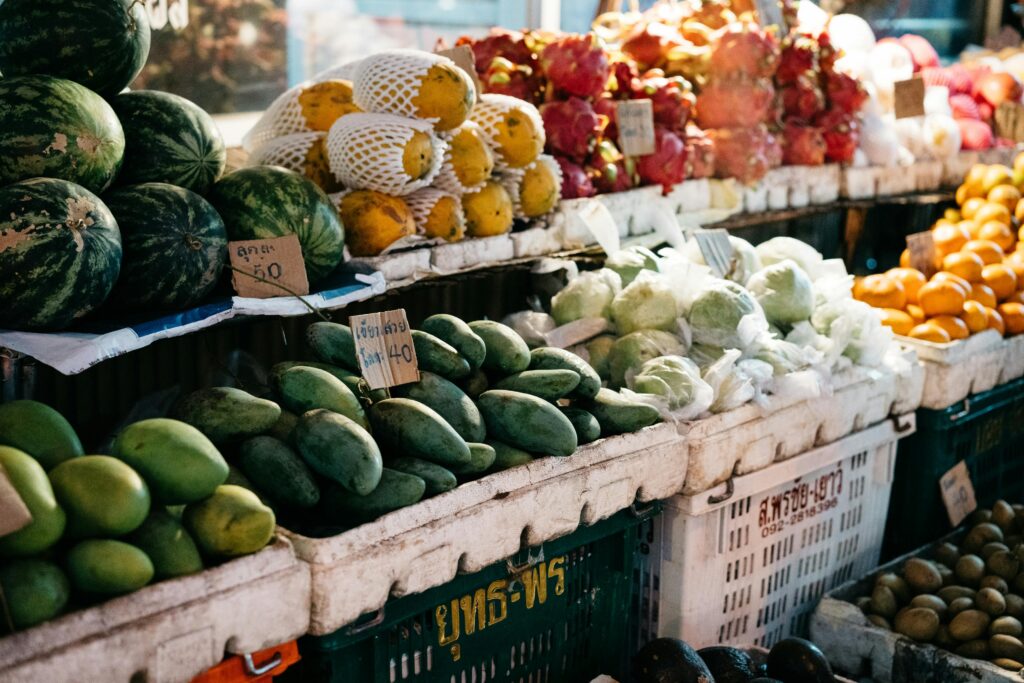
RoamRiot’s broader Bangkok eating guide is useful for understanding how Sukhumvit fits into the city’s larger food geography.
Not all Bangkok night markets are equal.
Some are mostly shopping markets with average food attached.
Some are tourist-heavy photo environments.
Some are genuinely strong food destinations.
Jodd Fairs became one of Bangkok’s most recognizable modern night markets because it balances accessibility with decent food quality.
Seafood. Grilled meats. Thai desserts. Fusion snacks. Fruit stalls.
The atmosphere is polished but still active.
Rot Fai Market in Srinakarin feels more local and less curated.
Vintage goods mix with beer bars and large food sections serving Isan dishes, fried chicken, grilled pork skewers, and sweets.
The crowd skews younger and more Thai.
Asiatique is visually attractive beside the river but functions more as an entertainment destination than a serious food market.
The food is acceptable.
The atmosphere matters more.
Talad Neon remains smaller and easier to navigate.
Useful for travelers wanting a lighter night market experience without the density of larger markets.
Night markets work best when approached slowly.
Do not rush.
One skewer here.
One dessert there.
A drink.
Another grilled item.
Bangkok rewards incremental eating.
For updated market locations and schedule changes, RoamRiot’s Bangkok shopping and markets guide remains useful because several markets have relocated repeatedly over recent years.
Bangkok’s riverside food culture moves at a different pace.
Softer.
Older.
More neighborhood-oriented.
Wang Lang Market across the Chao Phraya from the Grand Palace remains one of the city’s most satisfying daytime food areas.
Hospital workers, students, and locals dominate the crowd.
The market lanes are narrow and packed with snacks, curries, desserts, grilled meats, and old-school Thai cooking.
Mango sticky rice vendors here are particularly strong.
So are the curry stalls.
Arriving by ferry improves the experience considerably.
Bangkok makes more sense from the river.
The Charoen Krung area has also evolved rapidly in recent years.
Creative businesses, galleries, cafés, and old family-run eateries now overlap in ways that feel distinctly Bangkok.
Some of the best lunch-hour eating in the district still comes from tiny shophouse operations feeding office workers.
Simple roast pork over rice.
Noodle soup.
Braised duck.
Nothing designed for Instagram.
Just consistency.
Michelin recognition matters in Bangkok.
But not always in the way tourists assume.
The Michelin Guide Thailand has consistently acknowledged Bangkok street vendors because the cooking quality is too high to dismiss.
Bib Gourmand recognition in particular includes numerous street food establishments.
Current or recent Michelin-recognized names include:
| Vendor | Specialty | Location | Recognition |
|---|---|---|---|
| Raan Jay Fai | Crab omelette, seafood | Old Town | Michelin Star |
| Pad Thai Thip Samai | Pad Thai | Old Town | Bib Gourmand |
| Jok Prince | Rice porridge | Bang Rak | Bib Gourmand |
| Nai Ek Roll Noodles | Guay jub noodles | Chinatown | Bib Gourmand |
| Ong Kee | Pa tong go | Chinatown | Bib Gourmand |
| Urai Braised Goose | Braised goose | Song Wat | Bib Gourmand |
Recognition creates consequences.
Queues become longer.
Prices sometimes rise.
Operations become harder for aging vendors.
Some stalls lose part of their local identity under tourist pressure.
Jay Fai became the clearest example.
At the same time, many extraordinary Bangkok vendors remain completely outside Michelin coverage.
A lack of Michelin recognition means very little in a city with this much food depth.
Pad Thai matters, despite becoming over-touristed.
Proper pad Thai still deserves attention when done correctly.
The noodles should not stick together.
The tamarind should balance sweetness.
There should be smokiness from the wok.
Tom yum goong remains one of Thailand’s defining soups.
Lemongrass. Galangal. Lime leaves. Chili. Fish sauce.
Aggressively aromatic.
The broth should smell vivid before the spoon even reaches the mouth.
Boat noodles are darker and heavier.
Blood-enriched broth. Fried garlic. Herbs. Richness.
Victory Monument remains one of the best places to eat them.
Larb from northeastern Thailand combines minced meat with lime juice, fish sauce, roasted rice powder, herbs, and chili.
The roasted rice powder gives texture many visitors do not expect.
Mango sticky rice becomes dramatically better during mango season between roughly March and June.
Underripe mango destroys the dish.
Perfect Nam Dok Mai mango with fresh coconut cream turns it into something entirely different.
Thai dessert culture deserves more attention than it receives.
Khanom buang, crispy Thai crepes filled with coconut cream and sweet or savory toppings, require considerable technical skill.
The shell must stay thin and crisp.
Good vendors work quickly.
Kanom krok, coconut pancakes cooked in cast iron molds, should still hold soft liquid coconut center when eaten hot.
Lod chong with pandan noodles and coconut milk becomes especially valuable during Bangkok’s brutal hot season.
Thai desserts often emphasize texture as much as sweetness.
Soft coconut cream.
Chewy rice.
Crisp shells.
Shaved ice.
Warm custards.
Sangkaya fak thong, coconut custard steamed inside pumpkin, remains one of the more visually distinctive traditional desserts still found around parts of the Old Town.
Roti from Thai-Muslim vendors belongs in a separate category altogether.
Crisp buttery flatbread with banana, egg, condensed milk, or chocolate.
Usually eaten late.
Usually beside a hot griddle under fluorescent lights.
Bangkok mall food courts confuse many travelers because they are cheap, accessible, and sometimes surprisingly good.
Terminal 21 in particular built a reputation around low-cost meals.
Food courts serve a purpose.
Air conditioning matters during Bangkok heat.
Rainstorms matter.
Travel fatigue matters.
But food courts and street food are not interchangeable experiences.
Street food contains context.
Noise.
Smoke.
Speed.
Regular customers.
Wok sounds.
Direct interaction with cooks.
Food courts remove much of that.
At the same time, dismissing all food courts entirely is unnecessary.
Some vendors inside Bangkok food courts have operated there for years and cook genuinely strong versions of Thai dishes.
Still, anyone trying to understand Bangkok food culture deeply eventually needs the pavement-level experience.
Watching a cook handle a wok at full heat tells you more than reading ten travel blogs.
Bangkok street food hygiene is far less chaotic than nervous travelers often imagine.
The highest-turnover vendors are usually the safest because food moves constantly.
A busy noodle stall serving hundreds of bowls daily is not storing food for long.
The more realistic risks come from low-turnover vendors with ingredients sitting too long in heat.
Good signs include:
Tourists also misunderstand ice.
Commercial ice in Bangkok generally comes from regulated factories and is usually safe.
The bigger issue is hydration and dietary shock.
Many stomach problems happen because visitors suddenly consume extreme spice, heavy chili, unfamiliar fermented ingredients, large seafood quantities, and alcohol simultaneously.
Bangkok rewards pacing.
Thai food in Bangkok is not universally volcanic.
Many dishes are relatively mild.
Central Thai cuisine often focuses more on balance than pure heat.
Useful phrases:
Some dishes adapt easily.
Others do not.
Som tam and larb rely heavily on chili as structural flavor.
Removing most chili changes the dish fundamentally.
Isan food tends to be the hottest category many travelers encounter in Bangkok.
If a vendor looks skeptical when hearing “mai phet,” pay attention.
That hesitation usually means the dish was never designed to be mild.
Bangkok has a substantial Muslim community and strong halal food presence.
Pratunam and Phaya Thai contain numerous halal-friendly stalls serving khao mok gai, satay, roti, curry, and grilled meats.
The Ban Krua community near National Stadium remains historically important for Thai-Muslim culture.
Thai-Muslim cooking differs noticeably from Middle Eastern food found around Arab Street.
Massaman curry, mataba, and Thai-style biryani reflect long cultural mixing between Thai, Malay, Persian, and regional Muslim influences.
Halal travelers willing to move beyond tourist-heavy zones generally find Bangkok relatively manageable.
RoamRiot’s Bangkok dining guide provides broader neighborhood context for halal-friendly exploration.
Ordering at Bangkok street stalls becomes easier very quickly.
Pointing works.
Watching other customers works.
Most vendors understand basic food interactions with tourists.
At made-to-order stalls, learning protein words helps:
Condiment trays matter.
Fish sauce.
Sugar.
Dried chili.
Vinegar with chili.
Locals actively adjust flavor after tasting.
That is part of the meal.
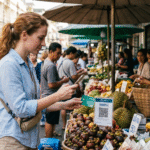
Do not negotiate prices.
Street food prices are generally fixed and already inexpensive.
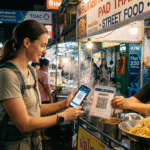
Cash remains useful despite increasing QR payment adoption.
Eating only at famous stalls limits the Bangkok experience dramatically.
Some of the best meals happen at completely anonymous places.
Another mistake is overcommitting to one large meal.
Bangkok works best in smaller eating stages.
One bowl.
Walk.
Another snack.
Dessert later.
Travelers also underestimate Bangkok heat.
April afternoons can become physically exhausting very quickly.
Hydration and pacing matter.
Another common mistake is avoiding stalls without English menus.
Google Lens translation handles Thai menus surprisingly well now.
Ignoring those stalls eliminates huge portions of Bangkok’s food culture.
Using GrabFood constantly is another missed opportunity.
Delivery is convenient.
But noodle texture degrades.
Crispy foods soften.
And most importantly, the atmosphere disappears.
Bangkok traffic changes food planning.
A short road journey can become painfully slow during evening rush periods.
The BTS and MRT together cover most major eating districts efficiently.
MRT works especially well for Chinatown and Old Town.
The Chao Phraya river boats are extremely underrated.
They bypass traffic entirely and connect directly with several historic food areas.
Suggested eating schedule:
| Time | Strategy |
|---|---|
| 6am–10am | Breakfast stalls, jok, khao man gai |
| 10am–1pm | Market exploration and daytime noodles |
| 1pm–4pm | Indoor break, cafés, food courts |
| 4pm–7pm | Riverside markets, early dinner |
| 7pm–11pm | Yaowarat, night markets, seafood |
| 11pm onward | Late-night noodles, roti, grilled meats |
RoamRiot’s Thailand transport guide remains useful for understanding Bangkok rail expansion and app-based transportation realities.
Bangkok remains remarkably affordable if eating where locals actually eat.
Approximate pricing:
| Food Type | Typical Cost |
|---|---|
| Basic rice dishes | 40–60 THB |
| Noodle soups | 50–100 THB |
| Desserts | 20–80 THB |
| Seafood dishes | 150–600 THB |
| Michelin-famous stalls | 100–1500 THB |
A traveler eating well across an entire day can realistically spend 400–800 THB without sacrificing quality.
Seafood and Michelin-famous vendors push costs upward quickly.
Cash still matters.
Many smaller stalls remain cash-only despite Bangkok’s rapid QR payment growth.
RoamRiot’s Thailand cost breakdown and PromptPay setup guides provide deeper tactical budgeting information for longer stays.
Delivery apps transformed Bangkok food culture.
Some effects are positive.
Smaller vendors gained larger audiences.
Residential-area stalls became accessible.
Late-night eating became easier.
But street food was originally built around immediacy.
Hot wok.
Immediate serving.
Immediate eating.
Delivery weakens texture and timing.
Especially for noodle dishes.
There is also a cultural shift.
Some stalls now feel more like production kitchens than neighborhood gathering points because so much business flows through delivery apps.
The best approach is balance.
Use delivery occasionally.
Still spend time physically exploring the streets.
Bangkok’s weather affects food exploration significantly.
Hot season from March through June is physically demanding.
Morning and night eating become far more comfortable.
The reward is peak mango season.
Rainy season between July and October brings heavy afternoon storms but usually leaves evenings usable.
Vegetarian Festival season during this period also transforms parts of Chinatown with temporary vegetarian food stalls.
Cool season from November through February is ideal for food-focused travel.
Lower humidity.
Better walking conditions.
Heavier crowds.
But overall the best balance for street food exploration.
For short stays:
One-day food strategy:
Three-day strategy:
Longer stays should include:
Bangkok street food becomes more rewarding the longer people stay.
Patterns emerge.
Favorite vendors emerge.
Entirely different neighborhoods begin making sense.
The Michelin Guide Thailand remains the most reliable source for current Michelin and Bib Gourmand status.
Austin Bush’s work documenting Thai food culture also remains among the strongest English-language resources available.
For broader Bangkok tactical travel planning, RoamRiot’s Bangkok guides cover neighborhoods, nightlife, transport, temples, cafés, and hidden districts in much greater depth.
Bangkok street food ultimately rewards observation more than aggressive optimization.
The city reveals itself gradually.
A small noodle stall under fluorescent lights.
An elderly couple running the same curry stand for decades.
Office workers silently eating breakfast before sunrise.
Plastic stools on wet pavement after midnight.
Smoke rolling out from charcoal grills while river humidity settles over Chinatown.
The work is not finding Bangkok street food.
The work is slowing down enough to understand what the city is actually showing.
Prices, stall and movables’ locations, transport routes, opening hours, and fees may change over time. Always verify current information before travel.
For more on Bangkok, explore RoamRiot’s full Bangkok travel guides collection including