Physical Address
304 North Cardinal St.
Dorchester Center, MA 02124
Physical Address
304 North Cardinal St.
Dorchester Center, MA 02124

Is Bangkok safe for tourists in 2026 Bangkok is one of the most visited cities on Earth. It is also one of the most scam-tested. This guide covers every active Bangkok tourist scam, safety risk, and prevention tip you need before you land.
Bangkok is safe for tourists. That answer holds up when you look at who actually visits the city and what they experience.
Millions of international travelers pass through Bangkok every year. Thailand’s Tourism Authority publishes annual visitor arrival data, and the country has consistently ranked among the most visited destinations in Asia. The vast majority of those visitors return home without anything serious happening to them.
Violent crime targeting tourists is not a defining feature of Bangkok. Muggings, armed robbery, and random attacks happen far less often than in many large cities around the world. The Thai government funds a dedicated tourist police force, operates a 24-hour English-language hotline (1155), and stations uniformed officers in orange vests near the most visited areas. Bangkok also has one of the most complete public transit networks in Southeast Asia, which keeps tourists moving safely across the city without depending on strangers for transport.
None of that means Bangkok is risk-free. Bangkok has scams. Quite a few of them. Some are low-level annoyances. A few can cost tourists thousands of dollars. And the ones that cause the most damage are not random street crime. They are organized, friendly, and practiced.
What makes Bangkok scams different from those in many other cities is how they start. Nobody grabs your bag. Nobody threatens you on the street. Instead, someone very pleasant starts a conversation, earns a small amount of trust, and guides you toward a situation where money flows out of your pocket and into theirs. By the time the bill arrives or the product turns out to be worthless, the damage is done.
This guide covers most of the active Bangkok tourist scams as of 2026. Read it before you go, and you will recognize every trick before it gets started.
Before diving deep into the guide check out the best areas to stay in Bangkok in this complete Bangkok stay guide.
Sukhumvit (Asok to On Nut) is the most tourist-friendly part of the city. It is well-lit, heavily used, connected to the BTS Skytrain at multiple stops, and packed with hotels, restaurants, and convenience stores at every turn. First-time visitors who stay in this corridor tend to have the smoothest experience.
Silom and Sathorn form Bangkok’s business and financial center. The streets here are calm and well-monitored. Patpong Night Market sits inside this area and carries its own risks covered below, but the wider neighborhood is safe and easy to navigate.
Siam and Ratchaprasong is the central shopping zone. Big malls, good transit connections, and a very visible police presence make this one of the safest stretches in the city for tourists who are new to Bangkok.
Ari and Phaya Thai are quieter residential and expat areas with fewer tourist traps. Restaurants here price for locals, not visitors, which also means less exposure to tourist-specific scams.
Riverside areas along the Chao Phraya near the Grand Palace, Wat Pho, and Wat Arun are busy and well-policed. The concentration of tourists also brings concentration of scammers in the immediate surroundings of the temples, which is covered in full in the transport scam section below.
Staying near BTS Skytrain or MRT Metro stations is the best general safety practice in Bangkok. Both rail systems are modern and clean. The areas around stations have better lighting, more foot traffic, and more reliable transport options.
Khao San Road draws backpackers from around the world. It is loud, busy, and lively. It is also where drink spiking has been reported by travelers, where overcrowded bars make it easy to lose track of your group, and where low-level Bangkok scams are more normalized than in other parts of the city. Going there with a group and a clear plan is fine. Going alone and accepting drinks from strangers is where things go wrong.
Patpong is Bangkok’s oldest red light district. Bar bill scams and ping pong show traps are still active here. Walking through it is not dangerous. Letting a tout guide you into a venue based on a price whispered on the street is how people lose money.
Nana Plaza and Soi Cowboy are adult entertainment areas on Sukhumvit. Both are more organized than Patpong but still carry active freelance scams, inflated bar tab tricks, and situations designed to separate solo male tourists from large amounts of cash.
Bangkok nightlife is a genuine part of what makes the city worth visiting. Rooftop bars, jazz clubs, basement venues, and riverside spots all exist here and most tourists enjoy them without any problems. The Bangkok nightlife scams that cause real damage tend to follow specific patterns that are easy to spot once you know them.
Drink spiking has been reported by travelers in Bangkok, particularly in nightlife-heavy areas like Khao San Road, Patpong, and Nana Plaza. Traveler accounts on major forums and advisories from several foreign embassies have flagged this risk specifically in Bangkok’s entertainment zones. The typical outcome is theft. The tourist becomes disoriented, and their valuables disappear.
Never accept a drink you did not watch being poured or opened. Do not leave your drink unattended at any bar. If you feel suddenly and severely dizzy after just one or two drinks, get to staff or a trusted companion immediately.
Traveling with others provides a real layer of protection here. When people are watching out for each other and noticing how everyone feels, the risk drops considerably.
Wondering how to enjoy Bangkok’s Nightlife to its fullest? Read:
This is consistently one of the most reported Bangkok tourist scams. A solo traveler, usually a man, is approached by one or two friendly people near a tourist area. After a short, warm conversation, they suggest going for drinks at a place they know nearby. The evening feels casual and enjoyable.
Then the bill arrives. The total is often 5,000 to 20,000 baht for drinks and a vague “show” charge that was never mentioned. When the tourist objects, larger staff members appear. Paying becomes the path of least resistance.
The thing to watch for is who suggested the venue. If a stranger recommended the bar and it was not a place you walked into independently, that is the pattern. Choosing your own bar, from a list of places with real online reviews, removes this risk entirely. If you end up with a bill that looks wrong, photograph it, ask for an itemized version in writing, and call 1155 from the premises.
A variation of this plays out in karaoke bars, where charges per song, per drink, and per companion are never disclosed upfront, and the final bill bears no relationship to what the tourist expected.
A tourist meets someone attractive, usually near a nightlife area or through a dating app. The connection feels real. The new acquaintance suggests a specific restaurant or bar. The tourist ends up paying far more than expected, because the venue has a deal with the person who brought them in.
A more aggressive version involves the tourist being taken somewhere private and then confronted by someone claiming to be a boyfriend, husband, or family member, demanding money to avoid a scene or further trouble.
In Bangkok, someone you just met who steers you firmly toward a specific venue rather than letting you choose is usually doing it for a financial reason. That is the thing to notice.
This is one of the most widely reported Bangkok nightlife scams and has been active for decades. A tout near Patpong or Nana offers entry to a show at a price that sounds reasonable. The tourist follows. The show exists. The bill at the end does not match anything that was quoted, with drinks, entry fees, and “private performance” charges appearing from nowhere.
Tourists who refuse to pay have described being physically blocked from leaving until they settled the bill. Embassy advisories from the UK, US, and Australia have specifically warned about this trap in Bangkok’s entertainment districts.
If Bangkok nightlife is part of your trip, choose venues independently, look for places with posted prices and real reviews, and avoid anyone on the street offering to take you to a special show.
Carrying too much cash on a night out makes a bad situation much worse. Bring what you need for the evening.
Not knowing your own location is a safety gap. Sharing a live location pin with someone at your hotel takes ten seconds and matters if plans change unexpectedly late at night.
Accepting a ride from a driver who approaches you outside a bar after midnight is almost always a flat-rate overcharge situation. Drivers stationed outside nightlife areas know that disoriented tourists rarely argue about the price until they arrive.
Taking a photo of the menu when you sit down takes five seconds. It eliminates the most common version of the menu-swap billing trick, where prices on the bill are different from what was displayed.
All licensed taxis in Bangkok are legally required to use the meter. Many drivers comply without any issue. But near airports, major tourist attractions, and late at night, some drivers refuse to start the meter and instead quote a flat fare.
That flat fare is almost always significantly higher than a metered trip would cost. A metered ride from central Bangkok to a Sukhumvit hotel typically costs 80 to 120 baht. A driver quoting a flat rate for the same journey might ask for 400 to 600 baht.
If a driver will not use the meter, get out. In any tourist area, another cab will come quickly. Asking the driver to use the meter is not confrontational. It is just asking for the legal standard fare.
At Suvarnabhumi Airport, the official metered taxi queue is on the ground floor arrivals level. Fares are metered with a 50-baht airport surcharge added, plus any expressway tolls. Any driver inside the terminal approaching you with a flat fare offer is not part of the official queue. A must read is how to get around Bangkok easily.
Tuk tuks are a real and enjoyable part of getting around Bangkok for short distances. The Bangkok tuk tuk scam comes in when a driver offers a ride at an unusually low price, sometimes 20 to 40 baht for a journey that would normally cost much more.
The cheap fare comes with a detour. The route passes through a gem store, a tailor, or another shop that pays the driver a commission for every tourist who walks inside, even briefly. Drivers in this circuit earn fuel vouchers or cash from stores per tourist delivered, regardless of whether anything is purchased.
Using tuk tuks for fun is fine. Agreeing on a price before getting in is standard. Accepting a suspiciously discounted ride near the Grand Palace or any major tourist site almost always means a commission detour is part of the deal.
This is one of the most reliably reported Bangkok tourist scams and it runs near the Grand Palace, Wat Pho, and Wat Arun on a near-daily basis.
A well-dressed stranger approaches a tourist near a temple entrance and says the temple is closed for a Buddhist holiday, a royal ceremony, or scheduled cleaning. But they know another lovely temple nearby that is open today, and there is a tuk tuk waiting that can take them there cheaply.
The temple being claimed as closed is open. The “alternative temple” route passes through shops that pay commissions for tourist visits.
Before visiting any major Bangkok temple, check the official opening hours online or on Google. If someone on the street tells you the temple is closed, walk to the entrance yourself. The truth is a two-minute walk away. If you’re looking to do a culture dive while in Bangkok, Bangkok Temples and Culture Dive guide is a must read!
Some taxi and tuk tuk drivers earn commissions by delivering tourists to specific hotels or shops rather than the destination the tourist requested. The driver claims the booked hotel is full, closed for renovation, or in a problematic area. The alternative they suggest pays them per tourist delivered.
Showing the driver your confirmed booking on your phone, with the address visible, removes most of the opportunity here. A driver who continues to argue after seeing a confirmed reservation is telling you what their actual motivation is. Getting out and taking a different vehicle is the right response.
The Bangkok gem store scam is one of the most financially damaging tourist traps in the city and has been flagged repeatedly in advisories from foreign embassies including the US, UK, and Australian missions in Bangkok. It has been running in various forms for decades.
The approach typically involves a friendly local or tuk tuk driver telling a tourist about a government-authorized gem sale, a one-day export promotion, or a special deal that allows tourists to buy Thai gemstones cheaply and resell them at a profit at home.
The gems sold are often real stones, but they are priced far above their actual market value. The resale profit story does not hold up. Tourists who have tried to sell the gems after returning home have found they are worth a fraction of what they paid.
Do not buy gemstones in Bangkok based on advice from anyone you met on the street or in a tuk tuk. If you want to buy gems legitimately, use an established jeweler with verifiable credentials and do not make purchasing decisions under time pressure.
Confused where to shop what in Bangkok? We’ve got you covered! Read Where To Shop in Bangkok by RoamRiot!
The same commission network that drives tourists to gem stores also drives them to tailor shops. A stranger or driver mentions a “government tailor” or “famous Bangkok tailor” that can produce a custom suit in 24 hours at a remarkable price.
Suits produced in 24 hours at a shop that relies on tourist foot traffic rather than repeat business tend to reflect that business model. Upfront deposits paid toward a suit that turns out unwearable are difficult to recover.
Bangkok does have excellent tailors. They are found through long-established shops with real track records and online reviews, not through commission-driven recommendations from drivers. Good custom tailoring also takes multiple fittings over several days.
Restaurants near the Grand Palace, along Khao San Road, and at some riverside locations sometimes display different prices to tourists than to local customers. The tourist-facing menu may show prices two to four times higher for the same food.
Walking a few streets away from the main tourist corridors usually brings prices down significantly. Eating where local workers and residents are eating is the most reliable way to avoid tourist pricing. When prices are not posted, asking before ordering is reasonable.
Someone approaches and identifies themselves as a plainclothes police officer or government inspector. They claim the tourist was seen exchanging money illegally, possessing drugs, or breaking a local regulation. They request payment of an on-the-spot fine or ask to search bags and wallets.
Thai police operate through official channels. Random plainclothes officers do not typically approach tourists on the street to collect cash fines. If someone claims to be police, ask to see their official ID and badge. Offer to accompany them to the nearest police station. Suggest calling the tourist police on 1155 to verify the situation.
People running this scam typically back off when official channels are mentioned. Real officers do not object to verification.
Do not hand your wallet or passport to anyone on the street who claims to be an authority figure.
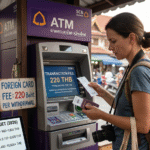
Card skimming devices have been reported on ATMs in tourist-heavy areas of Bangkok. A skimming device fits over the card slot and reads card data. A small secondary device captures the PIN as it is entered.
Using ATMs inside bank branches rather than standalone machines on the street reduces this risk. Covering the keypad completely when entering a PIN is good practice everywhere. If the card slot or any part of the ATM feels loose or looks like it does not sit properly, do not use that machine.
Using a travel card with a mobile app freeze feature means you can lock the card immediately if something feels wrong. Thailand ATM Fee Hacks is a must read if you’re looking to use ATMs while in Bangkok or Thailand in general.
Some exchange booths at tourist locations shortchange customers through distraction during the transaction, sleight of hand when returning bills, or adding an unannounced fee at the end of the exchange.
Well-regarded exchange operators in Bangkok include SuperRich (known for competitive rates) and Vasu Exchange, as well as exchange windows inside major bank branches. Counting the bills fully before walking away from any exchange is always worth doing. Airport exchange rates are usually significantly worse than rates available in the city. Changing a small amount at the airport for immediate needs and exchanging the rest in the city is the practical approach.
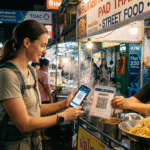
In some shops and markets, fake QR codes have been placed over legitimate payment codes. A tourist scans and pays, and the money goes to the scammer rather than the business.
Checking that the business name shown on the payment confirmation screen matches the actual business before approving the transaction takes only a second. For larger amounts, a card terminal or cash removes this risk entirely.
Be safe out there! And if you’re looking to setup QR code payments as a tourist, then this guide on how to setup PromptPay and PAY&TOUR without a Thai ID can be super helpful!
This scam is most concentrated in Phuket and Pattaya, where it has been documented in traveler reports, news coverage, and embassy advisories for years. It also appears at other beach areas accessible from Bangkok including Koh Samet and Koh Chang.
A tourist rents a jet ski. When they return it, the operator points to existing damage and claims the tourist caused it. Payment is demanded in cash. A nearby person, sometimes in uniform, agrees with the operator.
Photographing and videoing the entire jet ski before and after any rental, with visible timestamps, is the only reliable protection. Walking the machine with the operator before the rental begins and documenting every existing scratch or dent creates a record. If damage is claimed that is not in the pre-rental footage, the photos are the negotiating leverage.
The same pattern applies to motorbike rentals across Bangkok and surrounding areas. The tourist rents a bike, returns it, and is charged for damage that was either pre-existing or has been manufactured. The shop may attempt to hold the passport as security against payment.
Do not surrender a passport to any private rental business. Thai law does not give private businesses the right to hold foreign passports. A cash deposit, a photo of another ID, or a photocopy of the passport are alternatives to offer.
Some rental shops and a smaller number of guesthouses insist on holding a tourist’s actual passport rather than a copy or cash deposit. Once the passport is in their possession, the tourist is at a significant disadvantage in any dispute.
A guesthouse that holds the passport for longer than a brief check-in scan should be questioned. Any business insisting on retaining the passport indefinitely should be met with a request to speak with the manager and, if necessary, a call to 1155.
Passports are documents issued by a foreign government. No private business has legal authority to retain one as collateral in Thailand. Also, if your passport is even slightly damaged, Broken Passport Protocols is a must read for Thailand or Bangkok Travel.
Day trips and tours sold through guesthouses, street vendors, or unofficial operators sometimes misrepresent what is included, use vehicles or boats that are not as described, or involve guides who disappear once payment is collected.
Common problems include boats that do not go to the islands advertised, tours that spend most of the time at souvenir shops, and transport that is unsafe or far below what was described.
Booking through licensed agencies that have physical offices, transparent pricing listed online, and verifiable reviews reduces this risk considerably. For any boat-based day trip, checking that proper safety equipment is on board before departure is worth the extra minute.
At beach destinations reachable from Bangkok, some water sports vendors begin timing the rental before terms are agreed, or claim the rental ended earlier than it did. A tourist who paid for 30 minutes of equipment use is told they only used 5 minutes and is charged for additional time anyway.
Agreeing on the exact price, duration, and conditions in writing or on a phone screen that both parties can see before touching any equipment removes the ambiguity these vendors depend on.
Investment fraud disguised as romantic connection has been documented extensively in Thailand and across Southeast Asia. Sometimes called pig butchering scams, the pattern begins with a match on a dating app or a chance conversation online. Messages are warm and consistent. Over days or weeks, the conversation turns to a financial opportunity, usually a cryptocurrency platform that the other person uses and can share access to.
The platform is fraudulent. Returns displayed are fabricated. Money deposited does not come back.
No financial discussion that starts on a dating app or through an online connection should be acted on without independent verification from sources completely outside that relationship.
Thailand’s cannabis laws changed in 2022, and the legal landscape has continued to shift since then. Licensed dispensaries do operate in Bangkok. Unlicensed shops also operate, particularly near tourist areas, and some sell products at heavily inflated prices or sell synthetic substances that are not cannabis at all.
Prices at some shops near tourist areas can run 600 to 1,000 baht or more for a single gram of low-quality product. Licensed shops with clearly displayed menus, lab-testing information, and verifiable addresses are the safer option for tourists who choose to visit them.
Read more on Cannabis, Vaping, Social Media and Alcohol laws and stay informed before your travel!
Near major tourist areas, people approach travelers carrying clipboards or wearing branded vests, collecting donations for monks, disaster victims, or orphaned children. These are not affiliated with legitimate organizations.
Buddhist temple alms collections follow specific traditional forms and do not happen as street solicitations in tourist areas. Donating to any street charity collection is not recommended. If supporting Thai causes matters to you, donating through verifiable registered organizations is the appropriate route.
A few patterns persist at Bangkok’s main international airport despite ongoing enforcement efforts. Unofficial assistants at the arrivals hall offer to help with taxis, SIM cards, or transfers. They are not airport staff. The official taxi queue is on the ground floor and is clearly marked. Official SIM card desks from Thailand’s major carriers are inside the terminal.
Fake taxi desks positioned just outside the terminal or in the arrival area offer flat-rate transfers that are significantly more expensive than metered rides. Any desk that is not inside the official taxi queue structure on the lower level should be declined.
Bangkok is not particularly known for pickpocketing compared to some European tourist cities, but it does happen in specific environments. Crowded BTS Skytrain carriages during rush hour, the Chatuchak Weekend Market, and large festival or street fair crowds are the most common settings.
Keeping phones and wallets in front pockets or in a bag worn across the body and facing forward addresses most of this risk. Placing a phone on a table in a crowded open-air setting is the most common way people lose devices.
If Bangkok is your entry point and you plan to visit Thailand’s beach destinations, the scam environment changes in a few important ways.
Beach areas including Phuket, Pattaya, Koh Samui, Koh Samet, and Koh Chang have more concentrated rental scam activity around jet skis, motorbikes, and water sports equipment. The jet ski damage scam in particular is far more prevalent and aggressive at beach destinations than in Bangkok proper.
Pattaya’s Walking Street area has a well-documented bar tab and entertainment scam environment. Going in with a clear understanding of how the area works and what kinds of charges can appear uninvited is important preparation for anyone heading there.
Phuket’s Patong area requires the same awareness around rental scams, overpriced tours, and inflated nightlife bills that Bangkok’s entertainment zones require. Motorbike rental scams in Patong have been a consistent issue in traveler reports for years.
In both Pattaya and Phuket, some rental and entertainment operators have informal relationships with local officers that make disputing fraudulent charges more complicated than it would be in Bangkok. Having all rental evidence documented before the trip ends and escalating through the tourist police (1155) if disputes arise is the practical approach.
Solo travelers attract more scam attempts than groups, simply because there is no companion to offer a second opinion or interrupt a setup in progress. The most exposed moments are arriving somewhere new, making plans alone at night, and making quick decisions in unfamiliar situations.
Slowing down, using Grab for all independent transport, and checking Google reviews before entering any venue adds up to significant protection. Sharing your location with someone at your accommodation costs nothing and matters if something goes differently than planned.
Bangkok is widely regarded among solo female travelers as one of the more manageable cities in Southeast Asia. Serious violent crime targeting solo female tourists is rare based on available traveler reporting and embassy guidance.
Late-night transport from strangers should be avoided regardless of circumstances. Grab and Bolt provide tracked, accountable rides. Well-lit areas like Sukhumvit and Silom remain active late into the night and are generally comfortable for women walking alone. Trusting instincts in social situations at bars, particularly around accepting drinks, is the most important individual safety behavior.
Halal food is widely available in Bangkok. The Bang Rak and Saphan Kwai areas have established halal-certified restaurants, and most large shopping malls include halal food court options. Haroon Mosque near the riverside and Masjid Ton Son on Charoen Krung Road are accessible and well-known to local Muslim communities.
Bangkok is large enough that travelers who prefer to stay outside nightlife zones can do so easily. Sukhumvit has a wide range of accommodation and dining options that do not involve alcohol culture.
Bangkok with children is very manageable. Traffic and heat are the main practical concerns. The BTS Skytrain and MRT Metro are air-conditioned and easy to navigate with children. Major attractions have facilities suited to families.
Tuk tuks with young children are not recommended because of traffic exhaust and the open-air exposure to Bangkok road conditions. Grab or licensed taxis are better for family transport.
Markets and the area around the Grand Palace become crowded enough that keeping young children close and within sight is important. Disorientation in large crowds is the main risk, not crime.
After midnight in Bangkok, transport options narrow and the risk of pricing scams rises. Drivers who approach tourists outside bars and clubs at that hour are almost always operating at flat rates well above what the journey is worth.
Grab is the most reliable night transport option in Bangkok. Before confirming the ride, the app shows the full price, the driver’s name and photo, and the vehicle registration plate. The route is tracked throughout. This setup makes overcharging and other problems significantly harder to pull off. The live trip-sharing feature, which takes a few seconds to activate, allows someone at your accommodation to follow your journey in real time.
Bolt is a competing ride-hailing app available in Bangkok. It is worth having installed as a backup and often runs lower surge pricing at busy times than Grab.
Metered taxis during the day and early evening with a willing driver are fine. Late at night near entertainment zones, meter refusals become more common. Using Grab as the default from about 11pm onward avoids most of this.
Motorcycle taxis in orange numbered vests are useful for short hops during the day and early evening. Not recommended late at night or for longer distances.
Do not accept a ride from anyone who walks up to you outside a nightlife venue and offers transport.
People who live in Bangkok long-term behave differently near tourist areas than most visitors do, and the difference is instructive.
They do not engage with strangers who approach them near temples, markets, or tourist streets. A local walking past the Grand Palace does not slow down when someone calls out to them about a temple being closed. They know what this means and they keep walking. This is not unfriendliness. It is knowing the pattern.
They use apps before making any movement decision. Checking Google Maps takes 30 seconds and confirms whether a temple is open. Using Grab takes 90 seconds and guarantees a fair price for a ride. These habits are automatic for anyone who has lived in Bangkok for more than a few weeks.
They negotiate and confirm prices before anything begins. Before getting into a tuk tuk. Before sitting down at a street food stall without a posted menu. Before agreeing to any service. The price is stated and agreed before the interaction goes further.
They count change every time. At 7-Eleven, at a food cart, at a market stall. Counting change before walking away is the standard behavior, not a sign of suspicion.
They do not follow commission recommendations. If a driver or stranger enthusiastically recommends a specific tailor, gem store, or restaurant, Bangkok residents recognize that recommendation as financially motivated and do not act on it.
Travelers who apply these same habits from day one of their trip move through Bangkok much more like a local and encounter Bangkok scams much less frequently.
Stay calm. Getting visibly angry in Thailand rarely produces a better outcome and can make things harder to resolve. Staying composed keeps options open.
If you were overcharged or intimidated at a bar or venue: Leave the premises. Note the exact address and photograph the outside of the building if it is safe to do so. Call the tourist police on 1155. Provide the location, approximate time, and a description of what happened. Some tourists have recovered overcharged amounts through tourist police intervention because operators do not want the official attention that comes with a formal complaint.
If a taxi or tuk tuk demands more money mid-journey: Photograph the license plate and the driver if possible. Exit the vehicle. Use Grab for the rest of the journey. You can file a complaint with Thailand’s Department of Land Transport if you have the plate number.
If your card was skimmed: Freeze the card immediately through your bank’s app. Report the incident to the bank that owns the ATM machine. File a report at the nearest police station for travel insurance purposes. Many travel insurance policies require a filed police report for fraud claims.
If you were overcharged or sold worthless goods: Keep every receipt, packaging, and any written communication related to the transaction. Report the details to the tourist police on 1155 with the shop address and a description of what was sold. The Tourism Authority of Thailand also maintains a complaints process for tourist-facing fraud.
If you were drugged: Go to the nearest hospital immediately. Bumrungrad International Hospital, Bangkok Hospital, and Samitivej Hospital all have English-speaking staff and are experienced with these situations. Tell medical staff exactly what you believe happened. File a police report once you are able to. Contact your home country’s embassy if your passport or valuables were taken while you were incapacitated.
If your passport is being held by a business or guesthouse: Contact your country’s embassy in Bangkok. They can provide emergency travel documentation and advise on the local legal steps available to you. The tourist police (1155) can also assist with unlawful document retention by private businesses.
Save these before you arrive:
Tourist Police Hotline: 1155 (English-speaking, available 24 hours, covers scams, theft, and general tourist assistance) General Emergency: 191 Ambulance: 1669 Fire: 199 Tourism Authority of Thailand: 1672
Tourist police officers in orange vests are stationed near the Grand Palace, Khao San Road, Silom, and other major tourist areas. The 1155 hotline is staffed by English-speaking officers around the clock and handles everything from reporting scams to helping tourists who are lost or in dispute with a business.
Embassy contacts for urgent situations including passport loss, arrest, or serious medical emergency:
US Embassy Bangkok: +66 2 205 4000 UK Embassy Bangkok: +66 2 305 8333 Australian Embassy Bangkok: +66 2 344 6300 Canadian Embassy Bangkok: +66 2 646 4300
Storing at least one embassy number and the 1155 tourist police number in your phone before landing costs nothing and is useful preparation.
Before leaving your hotel:
At temples and tourist sites:
In nightlife and restaurants:
For money:
For transport:
Is Bangkok safe for first-time tourists? Yes. Bangkok is one of the more navigable large cities in Asia for first-time visitors. The public transport system is modern, English is widely spoken in tourist areas, and the tourist police infrastructure is accessible and functional. Bangkok tourist scams are real but avoidable with basic preparation.
Is Bangkok safe for solo female travelers? Generally yes. Serious violent crime targeting solo female tourists is rare based on available travel safety reporting. The standard precautions around late-night transport and not accepting drinks from strangers apply in Bangkok as they do in any major city.
What is the most common Bangkok tourist scam? The temple closed today scam and taxi meter refusal are the most frequently encountered. The bar bill scam causes the most financial damage per incident.
Is Bangkok safe at night? Most of Bangkok is safe at night with sensible habits. Use Grab for transport, choose your own venues with online reviews, and do not leave drinks unattended. The nightlife zones in Bangkok are not physically dangerous in general, but specific scam activity is concentrated there.
Are tuk tuks safe in Bangkok? For short rides at a price you negotiate before getting in, yes. The Bangkok tuk tuk scam is specific to drivers offering unusually cheap rides near tourist areas and then routing through commission shops. Using a tuk tuk for a ride you chose at a price you agreed on is a different situation.
Can tourists use ATMs safely in Bangkok? Yes, with reasonable precautions. Prefer ATMs attached to bank branches rather than standalone street machines. Cover your PIN. Use a travel card with an app-based freeze function so you can lock it immediately if anything feels wrong.
What should I do if approached by fake police in Bangkok? Ask to see official identification and badge. Suggest going to the nearest police station together. Offer to call the tourist police on 1155 to verify the situation. Scammers using this approach typically back off when these responses are offered. Real officers do not object to verification.
Is Thailand safe for tourists overall? Thailand is a major international travel destination and has been for decades. Bangkok, Chiang Mai, Phuket, and Koh Samui all receive large numbers of international visitors each year and have established tourist infrastructure and police presence. The country has known safety risks around specific scams and certain activities, but widespread danger to tourists is not the reality for the overwhelming majority of visitors who take reasonable precautions.
Bangkok is worth visiting. The food alone justifies the trip. The temples, the markets, the river, the neighborhoods that have nothing to do with tourists at all, the sheer scale and energy of the place, all of it is real and worth the trip.
The Bangkok scams in this guide are also real. They work on unprepared travelers because they are built on friendliness and misdirection rather than force. Knowing the patterns in advance changes the dynamic completely. A tourist who has read this guide recognizes the temple closed line, the cheap tuk tuk offer, and the new friend steering toward a specific bar within the first 24 hours of arriving. They simply keep moving.
Bangkok tourist safety is not about living defensively. It is about knowing where the specific risks are and not walking into them uninformed. The city does not require fear. It requires preparation.
Use Grab. Watch your drink. Check the meter. Choose your own bar. Count your change.
That is most of it. Go enjoy Bangkok.
To find out more on Scams in Thailand read the general Thailand Scam Safety Guide and Safe Travelling in Thailand.
RoamRiot publishes practical, verified travel safety content for independent travelers. Always verify information before travel. If you have encountered a scam pattern in Bangkok or Thailand not covered here, reach out to the RoamRiot editorial team.