Physical Address
304 North Cardinal St.
Dorchester Center, MA 02124
Physical Address
304 North Cardinal St.
Dorchester Center, MA 02124

The complete 2026 guide to Thailand SIM cards and eSIMs. AIS vs True Move H, Airalo vs Holafly vs Nomad, airport vs 7-Eleven, nomad setups, island coverage, technical APN settings, and exactly what to buy before you land.
Last updated: May 2026. Tested across Bangkok, Chiang Mai, Chiang Rai, Koh Samui, Koh Tao, and Phuket over multiple trips.
| Traveler Type | Best Option | Why |
|---|---|---|
| Short trip (1-14 days) | Airalo eSIM | Zero friction, activates before landing |
| Bangkok-only trip | True Move H or Airalo | Dense urban coverage, hotspot network |
| All of Thailand | AIS or Airalo | Strongest nationwide rural and island signal |
| Long-term stay (3+ months) | Physical AIS SIM from store | Cheapest per month, local number included |
| No eSIM-compatible phone | AIS from official store | Skip the airport, save 200-300 baht |
| Cheapest option overall | 7-Eleven AIS SIM | Lowest unit cost, requires passport eKYC |
| Most convenient option | Airalo eSIM pre-flight | No queues, no registration, live in 30 seconds |
Best overall for most travelers: Airalo running on AIS infrastructure. Activate before your flight, toggle on when you land, never stand in a telecom queue. For trips under 30 days it is nearly always the right call. Browse Airalo’s Thailand plans here.
Suvarnabhumi arrivals at any busy hour: you clear immigration, collect your bag, and right before the exit doors there are bright telecom counters staffed by people who know exactly what you need. You’re tired. Your phone is on roaming charges. You buy a SIM.
This is the most reliable tourist tax in the Thai travel experience, and it works because the friction cost of walking past those stalls feels higher than the price difference. It isn’t.
Airport SIM stalls from AIS, True Move H, and DTAC charge a significant premium over identical plans available in the city. A 15-day unlimited data SIM sitting at 600-700 baht at the arrivals counter costs 350-450 baht at a 7-Eleven branch three minutes from most city hotels. The staff are legitimate, the SIMs are real, and the plans work fine. You’re just paying a location premium.
The better play is setting up an eSIM before you board. More on that below.
If you do get caught needing a SIM at the airport, one tactical note: the True Move H counter at Suvarnabhumi typically moves faster than AIS during peak arrival hours (7pm to midnight) because repeat visitors specifically seek out AIS for nationwide coverage, creating a visible queue discrepancy. If you’re only in Bangkok and speed of purchase matters, True Move H gets you out faster.
Thailand has two networks worth discussing. The third, NT (National Telecom), is state-owned infrastructure primarily serving domestic fixed-line use. Ignore it.
Thailand’s largest carrier by infrastructure investment. AIS has spent more on rural tower expansion than any competitor, which is why their coverage map is the most complete in the country. They hold signal on the ferry route between Koh Lanta and Phuket where True repeatedly drops. They work in remote Isan villages. They function in the hills north of Chiang Rai where the road to the Myanmar border turns to gravel.
In Bangkok, AIS 4G LTE delivers 50-150 Mbps on a reliable basis and 5G is available in central areas (Sukhumvit, Silom, Siam, and along BTS corridors). The in-city experience is comparable to True. Outside the city, AIS has a genuine advantage that compounds the further you go from the tourist corridor.
The myAIS app has historically been clunkier than True’s equivalent, though recent updates have narrowed the gap. If you’re managing a long-term plan with add-ons and top-ups, True’s app is slightly more intuitive. For most tourists this is irrelevant.
The True-DTAC merger completed in 2023 combined two networks that previously competed on overlapping infrastructure. The merged entity is now the second-largest carrier by coverage and first by urban network density in Bangkok specifically.
True built an extensive supplementary WiFi hotspot network across the BTS Skytrain system, Central Group malls, and major public spaces that supplements cellular data seamlessly. In Bangkok, this is a real differentiator. Your phone switches between 5G/4G and True WiFi hotspots automatically, which helps with indoor coverage and battery life during heavy data days.
Outside Bangkok and the major resort cities, True’s network thins out. A solo road trip through Mae Hong Son or a slow travel route through Loei province will expose the gap with AIS. Not unusable, but noticeably less consistent.
Verdict: AIS for anywhere-Thailand coverage. True Move H for Bangkok-heavy trips where you want urban density and hotspot integration.
Covered above. They work. They are overpriced. The only scenario where they’re clearly the right call is a late-night arrival with no data, no offline maps, and no plan for getting from the airport to wherever you’re sleeping.
The budget traveler’s default, and genuinely the cheapest physical SIM option for standard plans.
Most 7-Eleven branches in tourist areas stock AIS and True Move H prepaid SIMs. The price advantage over the airport is real: 30-day unlimited plans (with high-speed caps) typically run 300-450 baht depending on the tier.
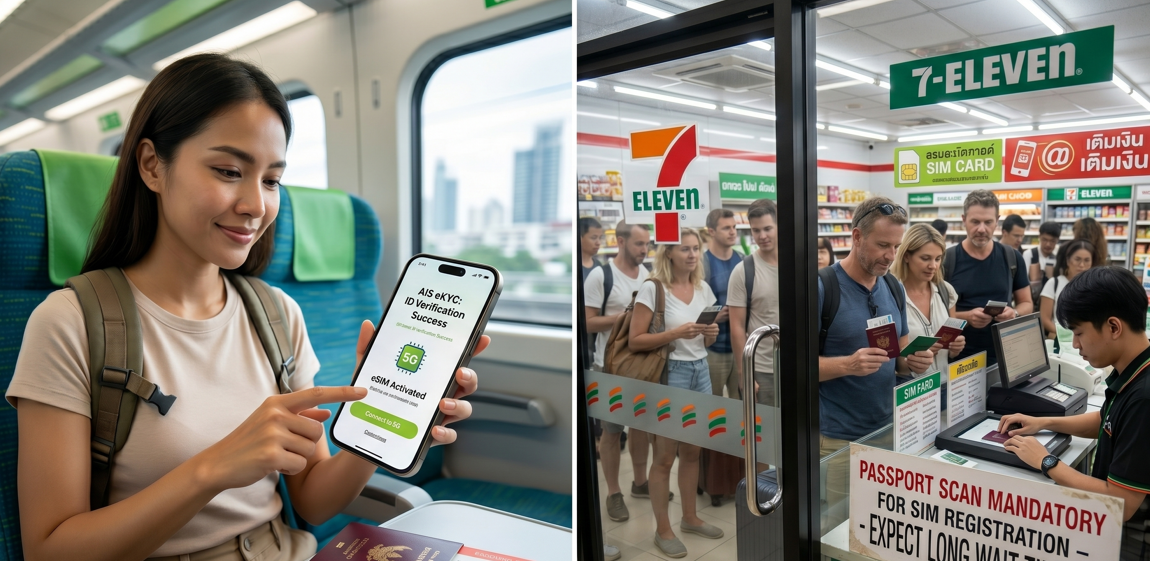
The friction: Thailand’s mandatory SIM registration law requires a passport scan at an eKYC terminal for every physical SIM purchase. At most 7-Eleven branches this takes 10-15 minutes with a clerk who knows the process. At others, it takes longer.
Specific things that go wrong at 7-Eleven SIM purchases in Thailand:
None of this is insurmountable. It is a collection of small frictions that stack up unpredictably. If you arrive at a functional branch with a trained clerk and a working terminal, you’re done in 15 minutes. If two of those conditions aren’t met, you’re walking to the next 7-Eleven.
The correct choice for tourists buying physical SIMs who want the 7-Eleven price without the 7-Eleven lottery. Official branded stores exist inside every major Bangkok mall and in the transit areas of Suvarnabhumi (past the arrivals hall, in the retail zone, not the counters right before the exit).
Staff at official stores speak usable English, understand tourist packages thoroughly, handle the eKYC registration cleanly, and can troubleshoot activation issues on the spot. Plan selection is broader than 7-Eleven, which stocks a limited subset of available packages.
For long-term stays specifically, the official store is where you go. Monthly plans, data rollover options, voice bundles, and proper documentation of your registration are all handled better here.
An eSIM is a digital SIM profile loaded onto your phone’s embedded chip. No physical card. No swapping. No clerk. No eKYC queue.
For Thailand specifically, eSIMs solve a problem that has gotten worse over time: the mandatory registration requirement for physical SIMs has added friction to every in-country purchase option. eSIM providers handle their compliance through digital identity verification at the point of purchase, before you ever leave home.
Phone compatibility check first: eSIM is not universal. Supported devices include iPhone XS and later (including all iPhone SE 2nd generation and later), Samsung Galaxy S20 and later, Google Pixel 3a and later, and most current flagship Android devices. Budget Android phones frequently lack eSIM support. Certain devices purchased in mainland China have eSIM functionality disabled at the hardware level regardless of the model name. Verify your specific device before purchasing any eSIM plan.
Dual SIM operation: Most eSIM-compatible phones support running an eSIM simultaneously with a physical SIM. The right setup is: eSIM carries all data, your home SIM stays active on the secondary line for SMS, calls, and banking verification codes. Do not remove your home SIM entirely. Thai services, foreign banking apps, and two-factor authentication systems will send verification codes to your registered home number at inconvenient moments.
Airalo is an eSIM marketplace. They wholesale carrier access (primarily AIS in Thailand) and sell it through their own app at competitive retail pricing. They do not own network infrastructure.
Why Airalo specifically leads the category:
Infrastructure: AIS network. This matters for anyone leaving Bangkok. Airalo users get the strongest rural and island coverage available through any eSIM provider in Thailand because they’re running on the carrier with the best map.
App quality: The Airalo app shows real-time data balance, allows top-ups mid-trip without purchasing a new plan, and has in-app customer support with response times that are genuinely fast compared to competitors. This sounds like a minor feature until your data runs out at Chiang Mai Night Bazaar and you need to add gigabytes in under two minutes.
Activation speed: Purchase, install QR code, arrive in Thailand, toggle on. The sequence from “phone exiting airplane mode” to “active 5G connection” is under 30 seconds in our testing at Suvarnabhumi.
Plan flexibility: Short-duration 1GB plans for long weekenders, multi-week high-speed plans for content-heavy trips, 30-day unlimited options for month-long stays. The ASEAN bundle covers Thailand plus Vietnam, Cambodia, Malaysia, and other regional destinations on a single plan, which suits travelers doing multi-country routes.
| Plan | Duration | Data (High Speed) | Approx. Cost |
|---|---|---|---|
| ASEAN Lite | 7 days | 1GB | ~$4.50 |
| ASEAN Standard | 15 days | 3GB | ~$9.50 |
| Thailand Pro | 30 days | 10GB | ~$14.00 |
| Thailand Unlimited | 30 days | 20GB + throttled | ~$19.00 |
Verify current pricing in the Airalo app before purchasing. Prices fluctuate with promotions.
These are the two eSIM providers travelers most often compare for Thailand. They are not equivalent products.
Holafly markets aggressively on “unlimited data” positioning. Their plans for Thailand offer unlimited data at full speed, which sounds like the obvious winner. The practical reality is more complicated.
Holafly runs on True Move H infrastructure in Thailand. For Bangkok-centric trips, the coverage difference versus Airalo’s AIS is negligible. For travel beyond Bangkok (islands, north, northeast), AIS has a meaningful coverage advantage that Holafly’s unlimited data promise cannot compensate for.
Holafly plans are also priced higher than comparable Airalo options in most duration tiers. The “unlimited” framing is appealing, but most travelers on a two-week trip do not consume enough data to justify the premium, particularly if they’re using hotel and café WiFi for heavy loads.
Holafly does not support top-ups within an active plan. If you underestimate your trip length and run past your plan’s duration, you buy a new plan from scratch.
Verdict: Airalo wins for most Thailand travelers on network quality (AIS vs True), pricing, top-up flexibility, and app experience. Holafly is a reasonable alternative for Bangkok-only trips where the coverage gap doesn’t matter and you specifically want unlimited speed.
| Feature | Airalo | Holafly |
|---|---|---|
| Network | AIS | True Move H |
| Nationwide coverage | Better | Good |
| Data cap | Yes (then throttled) | Unlimited speed |
| Top-ups mid-plan | Yes | No |
| Pricing | Lower | Higher |
| App quality | Better | Functional |
| ASEAN bundle | Yes | Yes |
Nomad is a smaller eSIM provider that has built a following among long-haul digital nomads specifically. Their Thailand plans use a combination of AIS and True Move H depending on the product tier.
Nomad’s high-data plans (50GB+) are worth considering for remote workers who do not want to worry about data management over a 30-day stay. Their pricing on these larger plans is competitive. The app is functional but less polished than Airalo’s, and their customer support response time is slower.
For standard tourist durations (7-30 days), Airalo’s pricing and app experience give it the edge. For nomads specifically doing 30-day stints who want a large data bucket and are comfortable with a slightly less refined app experience, Nomad is worth a comparison check before purchasing.
| Feature | Airalo | Nomad |
|---|---|---|
| Network | AIS | AIS + True |
| App quality | Better | Functional |
| Large data plans (50GB+) | Limited | Strong |
| Top-ups | Yes | Limited |
| Best for | Most travelers | Heavy data nomads |
AIS now offers eSIM products through their own channels and through the myAIS app. This is technically the same network infrastructure as Airalo, so coverage is identical.
The AIS direct eSIM requires downloading the myAIS app, completing digital KYC with a passport upload and liveness selfie, and navigating an app that is significantly less intuitive than Airalo’s for non-Thai speakers. The documentation process is longer, the English UI has gaps, and customer support for foreign users is inconsistent.
Pricing on AIS direct is sometimes marginally cheaper than Airalo for longer-duration plans. The experience cost is higher. For most non-Thai travelers, Airalo’s interface advantage justifies the small price difference. For someone on a 90-day stay who speaks some Thai or is comfortable with more complex app navigation, the direct AIS eSIM is worth investigating.
| Factor | Physical SIM | eSIM |
|---|---|---|
| Price (short trip) | Moderate | Equal or cheaper |
| Price (long stay) | Cheaper | More expensive |
| Setup time | 15-45 minutes | Under 5 minutes |
| Registration required | Yes, passport eKYC | No (done at purchase) |
| Local phone number | Yes | Requires voice add-on |
| Works before landing | No | Yes |
| Multiple device use | One device | One device |
| Flexibility if lost/stolen | Buy replacement | Reinstall or transfer |
Physical SIM wins for: long-term stays, travelers who need a Thai local number from day one, anyone on a tight budget doing 30+ days.
eSIM wins for: short to medium trips, first-time Thailand visitors, anyone who values time over the marginal cost difference, and travelers who have had bad experiences with 7-Eleven SIM registration processes before.
For a one-week trip, Airalo’s ASEAN Lite (1GB) or Standard (3GB) plan is the cleanest option. At $4.50-$9.50, it is often cheaper than the equivalent airport physical SIM and dramatically simpler to set up. If you’re doing heavy navigation, social media posting, and occasional streaming, go for the 3GB tier to avoid running out mid-trip.
If you specifically want a physical SIM for a 7-day trip, the 7-Eleven AIS 7-day tourist package is your cheapest option at roughly 250-300 baht.
Airalo’s 15-day ASEAN plan at around $9.50 is the right default. For heavier users (content creators, people on video calls), step up to a 30-day plan for the higher data cap, even if you won’t use the full 30 days. The cost difference is small and the headroom is worth it.
Physical SIM option: AIS 15-day tourist package at an official store for approximately 399-499 baht, which includes unlimited data with a 30GB high-speed cap.
This is where physical SIMs start competing seriously on price. An AIS 30-day unlimited plan from an official store costs roughly 600-800 baht ($17-$23), depending on the tier. Airalo’s 30-day unlimited runs approximately $19. The price gap is minimal enough that most travelers still benefit from Airalo’s setup convenience.
Exception: if you are making video calls daily, uploading large files regularly, or tethering a laptop for hours at a time, consider the official AIS store for a physical SIM with voice included and the ability to manage your plan in person.
Physical SIM, full stop. Buy an AIS or True Move H SIM from an official branded store, complete the one-time eKYC registration, and get on a monthly unlimited plan. You’ll pay significantly less per month than any eSIM marketplace option, you’ll have a Thai local number for banking and services, and the registration is a one-time inconvenience rather than a recurring cost.
At 90-day length, you may also want to explore AIS’s longer-term postpaid options, which require a deposit but offer better pricing than prepaid.
7-Eleven AIS SIM. Bring your passport, accept the 15-minute registration process as part of the arrival ritual, and get the cheapest daily data rate available. AIS covers the guesthouses, overnight buses, river crossings, and secondary towns that backpacker routes use. The registration friction is front-loaded and then it’s done.
One backpacker-specific note: the 7-Eleven branches directly on Khao San Road and in the immediate Banglamphu area are very experienced with foreign passport registration because they process them constantly. If you’re basing yourself there initially, that’s a low-friction entry point for physical SIM purchase.
Airalo, bought the night before your flight. Arriving in Bangkok for the first time is disorienting enough without adding a SIM purchase logistics problem to the first hour. You need Google Maps, Grab, and the ability to contact your accommodation working from the moment you clear immigration. Set this up from home and it’s one less thing to manage.
Airalo 30-day unlimited plan with your home SIM active on the secondary line. Thai 5G tethering in Sukhumvit and Nimman Road in Chiang Mai is fast enough for video calls and cloud work without relying on café WiFi. Budget your high-speed data and use hotel/co-working WiFi for the heavy uploads.
The specific setup that works well: Airalo eSIM as primary data, home SIM on WiFi calling for receiving international calls, and LINE app with a Thai number (can be set up even without a local SIM) for communicating with Thai services.
Official AIS store, physical SIM, monthly plan. The economics shift completely. The eSIM convenience premium makes zero sense over a 60 or 90-day stay when you can pay once at a store and have a better-priced plan for the entire duration. Get a Thai number while you’re at it. It opens up PromptPay, LINE Pay, and local banking integrations that make daily life in Thailand significantly smoother. For more on the payments side, the Thailand PromptPay and banking guide covers exactly what you need.
Suggested read: Digital Nomad Setup Guide in Thailand
Airalo for anything under two weeks. Clean setup, professional-grade reliability, no time wasted on telecom logistics during a packed schedule. True Move H coverage is excellent throughout Bangkok’s business districts (Silom, Sathorn, Asok), and Airalo’s AIS infrastructure covers all of them just as well.
If your business trip extends beyond Bangkok to industrial zones or secondary cities, the AIS coverage advantage reasserts itself.
Airalo for each eSIM-compatible device, one purchase per device handled from home. Coordinating multiple passport registrations at a Thai 7-Eleven with children is an experience you don’t need. Buy the eSIMs, set them all up before the flight, and that’s the last time anyone thinks about connectivity logistics.
For non-eSIM devices (an older shared tablet, a child’s hand-me-down phone), the official AIS store is more family-friendly than 7-Eleven for the registration process.
AIS is the network for this use case, either through Airalo or a physical SIM depending on trip length. The specific workflow consideration: mobile uploads for Instagram and YouTube Shorts are fine on 4G/5G, but anything above 2-3 minutes of 4K video will burn through your high-speed data allocation faster than expected.
The practical approach: use cellular for immediate social posting and small file uploads. Route larger files through hotel WiFi or co-working space connections. Bangkok 5G in central areas will push upload speeds of 40-80 Mbps in favorable conditions, which handles most content creation workflows adequately as a backup when WiFi isn’t available.
AIS or Airalo. This is not negotiable. True Move H’s coverage on smaller islands is significantly worse than AIS, and island connectivity is already the weakest part of Thailand’s network infrastructure. Koh Tao gets congested during peak season regardless of carrier, but AIS holds signal longer on boats and at beach edges where True goes quiet.
Specific island notes below.
Tested across multiple visits.
Phuket: Both AIS and True are solid. Main tourist beaches and Phuket Town have excellent coverage. The west coast road between beaches occasionally has gaps regardless of carrier.
Koh Samui: Strong coverage from both networks throughout the island ring road and tourist zones. The interior is less reliable.
Koh Phangan: Good coverage in Haad Rin and main west coast areas. Full Moon Party periods create severe network congestion from sheer user density. Plan accordingly: download offline maps, queue the Grab booking before you need it.
Koh Tao: AIS covers the main dive areas and town. True is noticeably weaker. Neither carrier gives you reliable signal at depth (obviously), but above water in the shallows around the eastern side of the island, AIS holds where True doesn’t.
Koh Lipe: Surprisingly decent on AIS given its distance from the mainland. Basic video calls work from the main sandy beach area. True’s signal on Lipe is unreliable enough that it should not be your network choice for an island-heavy southern trip.
Koh Chang: AIS covers White Sand Beach, Lonely Beach, and the main ring road areas. The eastern side of the island has significant gaps in both networks.
Koh Kood: The most beautiful and least connected of the easily accessible eastern Gulf islands. AIS works in the main resort area on the west coast. The eastern shore has dead zones. Download offline maps before taking a boat here regardless of your carrier.
Similan Islands (liveaboard): No reliable coverage anywhere on the open water. This applies to all carriers. Expect to be offline during dive trips. This is not a network quality issue.
The remote work connectivity question has a more nuanced answer than most SIM guides give it.
Thai mobile data is fast enough in Bangkok and Chiang Mai to function as a primary connection for most remote work tasks: video calls, cloud document access, email, Slack. The issue is not speed, it is consistency and the specific locations where you’re working.
Locations where Thai 5G/4G is a reliable primary connection:
Locations where you should treat mobile data as a backup to WiFi:
For sustained remote work, the recommended setup is a 30-day AIS plan (via Airalo or physical SIM) with a minimum 20GB high-speed data allocation, used strategically for commuting and away-from-desk hours, with co-working WiFi handling the heaviest tasks.
Thai co-working spaces in Bangkok (HUBBA, The Hive, Spaces) and Chiang Mai (CAMP, Mango, Yellow) all offer reliable WiFi. Budget for co-working day passes if you’re doing intensive video editing, large uploads, or sustained conference calling. Mobile data as your only option for eight hours of work per day will burn through even large data plans quickly.
Most travelers never need to touch these settings. For those who do:
If your SIM activates but data does not work, a manual APN configuration usually fixes it.
AIS:
True Move H:
These settings apply on iOS (Settings > Cellular > Cellular Data Network) and Android (Settings > Connections > Mobile Networks > Access Point Names).
Airalo eSIMs configure APN automatically during installation. You should not need to set these manually for an Airalo plan. If you do, contact Airalo in-app support.
All major Thai SIM plans allow hotspot tethering. There is no separate tethering add-on required. Your high-speed data allocation applies whether you’re using data directly on the SIM device or sharing it to a laptop via hotspot.
Tethering to a laptop noticeably increases battery drain on the phone acting as a hotspot, especially during sustained use. A portable power bank is practical equipment for anyone using their phone as a primary hotspot for work.
Thailand’s 5G deployment uses:
Most current flagship phones support these bands. If you have a mid-range Android or a phone purchased more than two years ago, check your device’s 5G band compatibility. 4G LTE is fully sufficient for most use cases and has broader device compatibility.
Running two active SIMs simultaneously increases battery consumption by approximately 10-15% compared to single-SIM operation. This is because the phone maintains two independent radio connections. If battery life is a concern on a heavy travel day, consider putting your home SIM in “data only from eSIM” mode rather than full dual-radio operation.
AIS and True both support 4G carrier aggregation (combining multiple frequency bands for higher speeds). This is enabled automatically when the network conditions support it and your device is compatible. You don’t configure it manually. The practical effect is that in good signal areas you may see speeds that seem higher than expected for 4G LTE, which is carrier aggregation working correctly.
Yes, but the word “unlimited” requires context.
Every “unlimited” plan from every Thai carrier uses a tiered speed structure. You receive a high-speed data allocation (typically 15-30GB depending on the plan tier), after which your connection is throttled.
Throttled speeds on Thai SIMs generally fall between 1-3 Mbps. At 1 Mbps:
If your use case requires consistent high-speed performance across an entire trip, either purchase a plan with a high-speed cap large enough for your usage pattern, or carry a plan with genuine top-up capability (Airalo supports this) for when you hit the cap before your plan expires.
Yes. Thai law permits foreign nationals to purchase SIM cards. The mandatory requirement is real-name registration linking the SIM to a valid passport. This applies to all purchase channels: airport counters, 7-Eleven, official telecom stores, and online purchases with shipping.
The registration is not optional and cannot be bypassed through any legitimate channel. SIMs registered to someone else’s identity (purchased pre-activated from informal vendors) are subject to remote deactivation by Thai authorities.
Bring your passport to any physical SIM purchase. eSIM providers handle the identity verification digitally during the online purchase process, typically requiring a passport photo upload and in some cases a liveness verification selfie.
Which SIM works best in Phuket? Both AIS and True Move H have strong coverage in Phuket’s tourist zones and airport. AIS has a slight edge in the less-developed north of the island and on ferry routes to surrounding smaller islands.
Is Airalo better than Holafly for Thailand? For most Thailand trips, yes. Airalo runs on AIS (better rural and island coverage), costs less in most plan tiers, allows mid-plan top-ups, and has a better app. Holafly’s advantage is unlimited speed data, which matters less in practice than it sounds for trips under 30 days.
Does Thailand airport have free WiFi? Suvarnabhumi has free WiFi available throughout the terminal, including arrivals. Speed is variable and congestion is common during peak hours. It works for basic tasks but is not reliable enough to substitute for a data plan. Don Mueang also has free WiFi, slower and more congested than Suvarnabhumi.
Can I use WhatsApp with a Thai SIM? Yes. WhatsApp, LINE, iMessage, FaceTime, and all standard messaging and call applications work normally on Thai data. No restrictions apply to these services.
Can foreigners register SIMs in Thailand? Yes, with a valid foreign passport. The passport must be physically present at the point of purchase for a physical SIM. For eSIM purchases through platforms like Airalo, digital passport verification is completed during the online purchase flow.
Can I use hotspot tethering on Thai SIM plans? Yes. All standard prepaid and tourist plans from AIS and True Move H allow hotspot tethering at no additional cost. Your high-speed data allocation is shared across direct device use and hotspot use.
Which SIM is best for YouTube uploads? AIS for upload speed stability. In Bangkok 5G areas, AIS posts upload speeds of 30-80 Mbps in good conditions. For consistent upload performance across different locations (not just central Bangkok), AIS’s broader coverage means you’re rarely uploading from a degraded connection.
Can I use one SIM across ASEAN countries? Thai SIMs do not include regional roaming by default. You would need to add an international roaming package, which is available from AIS and True Move H but expensive. The better solution for multi-country travel is Airalo’s ASEAN bundle, which covers Thailand plus surrounding countries on a single eSIM plan at a flat regional rate.
Is eSIM faster than a physical SIM? No. Speed is determined by the carrier network, not the SIM format. An Airalo eSIM running on AIS and a physical AIS SIM give you the same network speeds because they’re on the same infrastructure.
Does Thailand SIM work with a local number for banking? Physical SIMs include a Thai local number. eSIM data-only plans from Airalo do not include a local number by default. If you need a Thai number for PromptPay registration, K-Bank PAY&TOUR setup, or local app verification, a physical SIM is necessary. See the PromptPay guide for foreign visitors for the full setup process.
What happens if my eSIM fails at the airport? Airalo’s in-app support is responsive. Have the app open and your QR code saved in your camera roll as a backup. If the eSIM fails to activate, airport free WiFi is sufficient to contact support or troubleshoot. As a final backup, every Thai airport has physical SIM counters in arrivals.
How do I check my remaining data on an Airalo eSIM? Open the Airalo app and your active plan shows real-time data balance. On iPhone, Settings > Cellular also shows a data usage counter (note this counter doesn’t reset automatically; use the Airalo app for accurate plan-specific tracking).
Can I keep my Airalo eSIM after it expires for a future trip? The eSIM profile stays on your phone but the data plan expires. You can purchase a new plan from Airalo and apply it to the same eSIM profile without reinstalling, which speeds up setup for return trips.
The coverage claims and carrier comparisons in this guide are based on direct testing across Bangkok, Chiang Mai, Chiang Rai, Koh Samui, Koh Tao, and Phuket during 2025-2026 trips, supplemented by AIS and True Move H official coverage maps and Opensignal network quality reports. Pricing figures are approximate and verified against current carrier and Airalo app listings as of May 2026. Prices change with promotions and plan updates; treat all figures as reference points and verify in-app before purchasing.
Traveling 1-14 days: Airalo eSIM. Buy it tonight. Set it up before you board. Walk past the airport counters with the quiet satisfaction of someone who already has internet.
Traveling 15-30 days: Airalo 30-day plan, or an AIS physical SIM from an official store if you want to save a few dollars and don’t mind the registration process.
Bangkok only: True Move H or Airalo. Either works well.
Travelling all of Thailand including islands and rural areas: AIS, accessed through Airalo or a physical SIM depending on your stay length.
Staying 3+ months: Official AIS or True Move H store. Physical SIM. Monthly plan. Do it once, do it properly.
No eSIM support on your phone: Official AIS store in the city. The airport counter premium is real money across a two-week trip.
The single decision that eliminates the most friction for the most travelers is buying an Airalo eSIM before departure. Everything else is an optimization around that baseline.
Once you have connectivity sorted, here’s what to handle before arriving: